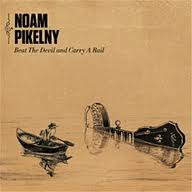
Noam Pikelny’s “Beat the Devil and Carry a Rail”

For KDHX Radio, St. Louis

In “Beat the Devil and Carry a Rail,” his latest solo release, Noam Pikelny has created a moving, playful collection that features so much top-flight playing it can make your head spin.

Pikelny’s main gig these days is as banjo player for the Punch Brothers, a band that he co-founded with Chris Thile. It’s a group known for pushing against, whenever not wholly ignoring, the traditions of bluegrass, a musical style from which the group takes its instrumentation. To say that they do it well is an understatement. Since they formed they’ve been at the epicentre of progressive acoustic music, skilfully charting new territory in an old musical world.

Continue reading “Noam Pikelny’s “Beat the Devil and Carry a Rail””

Top Discs of 2011

For KDHX Radio, St. Louis

Music isn’t a sport though the idea of a top 10 list can make it seem competitive. It isn’t like that, of course, but there are some recordings that are, well, better than others.

The Wailin’ Jennys, “Bright Morning Stars”
Good lord I love this recording, I could go on and on. Varied, beautiful, and pristine.

Sarah Jaroz, “Follow Me Down”
Oh man, this is a great one too. Jaroz’s cover of Dylan’s “Ring Them Bells” has haunted me, but in a good way. Everything else here is equally brilliant.

Chris Thile and Michael Daves,  “Sleep With One Eye Open”
Weird, perhaps, as is the love they profess to the Louvin Brothers. Still, this album is even better than we thought it would be, had we had a chance to think about it.

Sierra Hull, “Daybreak”
This is just a beautiful album with impeccable presentation. The material is a bit heavy on young love, but, she’s young, so she’s entitled, and the sterling musicianship makes up for it.

Gillian Welch, “The Harrow and the Harvest”
Another gorgeous, long awaited album from a truly inspired and inspiring writer and performer.

Caroline Herring, “The Little House Songs”
This is the first album from Herring intended for a child audience, though it’s also a great collection of new work from one of my favourite writers and performers. The CD retells the story of the house in the children’s book The Little House by Virginia Lee Burton. It’s what any great kids album should be—a collection that both kids and adults enjoy listening to.

Blue Highway, “Sounds of Home”
This band is always  so solid and tasteful, and their writing just takes me away. Nothing too thick or heavy, just great song writing presented by a set of stellar musicians.

The Kruger Brothers, “Appalachian Concerto”
If banjo is America’s only indigenous instrument, at least in popular music, then this long overdue: the banjo in classical setting, telling the story of a part of the world where banjo music comes from. But, even if we place all of that aside, this concerto still stands on its own.

Noam Pikelny, “Beat the Devil and Carry a Rail”
This a seminal work from a fantastic musician with, it turns out, lots of high flying friends. Challenging, listenable, funny—all of that and more on a superbly produced album from the banjo player from the Punch Brothers.

The Laws, “Try Love”
This album doesn’t make the same kind of splash that some of the others on this list do, but it’s a disc that stayed in the CD player in the car for quite a long time this year.

Top 10 Banjo moments of 2011

Derided in countless jokes, often by the very people that play it, the banjo just might be poised to show us why it really is the greatest instrument ever. Or, at the very least, to make a good case as to why it isn’t the worst.

  1. Jens Kruger releases the “Appalachian Concerto,” an homage to the banjo and its place in the history of Appalachia. And it’s a concerto. With, like, strings and everything.
  2. Noam Pikelny releases “Bluegrass Diva” a video that is not only funny, but includes some of the most notable players of the instrument ever, including Bela and Earl. And, for once, it’s the singing that makes the piece funny, not the presence of a banjo.
  3. Bela Fleck premieres his “Concerto for Banjo and Orchestra.” Hmm, that makes two banjo concertos this year …
  4. Steve Martin releases a banjo album with a title intended to poke a bit of fun at birdwatchers. (How’s that for the pot calling the kettle black?)The strength of “Rare Bird Alert” helps make Martin and the Steep Canyon Rangers the IBMA performers of the year.
  5. Eight year old Jimmy Mizzone records a version of “Flint Hill Special” with his two brothers in his bedroom that, when posted to youtube garners, like, a gazillion hits.
  6. Steve Martin awards his second Steve Martin Prize for Excellence in Banjo and Bluegrass to Sammy Shelor on Letterman. It’s $50,000 of his own money, simply because he thinks banjo is a great instrument and deserves a better rap.
  7.  “Give Me the Banjo” airs in primetime nationally on PBS. It’s a slick documentary about why banjo matters. Haven’t seen anything like that for the guitar, have you? Only saying.
  8. Kermit goes back to the big screen, plays the banjo, and nets millions on the first weekend of release.
  9. With the release of “Follow Me Down”  Sarah Jarosz demonstrated once again that “banjo prodigy” isn’t a contradiction in terms. (The New York Times called her that in their coverage of the Grammies this year.)
  10. Thanks to Abigail Washburn’s “City of Refuge,” released this year, NPRs Bob Boylen fell in love with a banjo album and admits it on air.

Sarah Jarosz’s “Follow Me Down”

If Sarah Jarosz is unfamiliar to you, the support she has on her second album, released just shy of her 20th birthday, will ring lots of bells: Bela Fleck, Edgar Myers, Dan Tyminski, Shawn Colvin, Darrell Scott, Mark Shatz, Jerry Douglas, Chris Thile, Noam Pikelny, and the list of guest artists just keeps going. By any measure, she’s gathered an all-star line up and then some and in so doing she has placed herself in a league of heavy hitters. Given her playing, writing and interpretive skills, that’s exactly where she deserves to be. This a young musician who seems to know who she is and where she wants to go, and who has the level of musicianship that she needs to get there.

There are only two covers on the latest album, Follow Me Down, but both are prime examples of what Jarosz is up to, which is to bring something new to something old. On her beautiful take of Bob Dylan’s “Ring Them Bells,” she arguably creates the song entirely. By presenting it in such a different way—gently, lyrically—she separates the sentiment of the piece from the peronsa of Dylan himself. There’s a lot of brilliance there, and Jarosz lets us see it. On “The Tourist”—a Radiohead song and the other cover on the release—she matches the drive, confidence, and musicianship of Chris Thile and the Punch Brothers, who are featured on the track

Of course, all of that is really saying something. In the world of acoustic music, the Punch Brothers are the crest of a wave of young musicians who, with spectacular chops and equal confidence, are putting the grit and energy back into acoustic and bluegrass-based music. These are young people—Chris Thile and Michael Daves, Crooked Still, Darrell Scott, Abigail Washburn, the sadly disbanded Cadillac Sky—who not only are willing to update the tradition but are able to do it with astonishing credibility, bringing in pop elements, new instrumentation, and references from urban culture.

So too does Sarah Jarosz. Her music is challenging, layered, complex, and beautiful, and based in a broad, rich swath of American music. In Jarosz’s world the Louvin Brothers and Bill Monroe sit comfortably next to Radiohead and Tom Waits. It’s a world where old-time songs, as in the case on the haunting “Annabelle Lee,” can have a drum kit; one where she can play clawhamer banjo one moment, and a masterful mandolin duet with Mike Marshall the next.

Her writing is fresh and bold, and sparkles most when delivered in the first person as on songs like “Run Away” and “Here Nor There” (a track which, incidentally, pairs her vocal wonderfully with that of another brilliant singer and songwriter, Darrell Scott).  It’s a testament to her writing that it’s hard to tell the new from the old, the originals from the covers.

In the end Jarosz reminds us that, in many ways, youth, energy, and experimentation is perhaps the only truly abiding hallmark of American music. Bill Monroe didn’t sit back and play the music from the past, rather he took those traditions and made something new. And that’s exactly what Sarah Jarosz is doing, too. It’s safe to say that, if her name is unfamiliar now, it certainly won’t be for long.

Si Kahn then, Si Kahn now

Published in Penguin Eggs, Autumn, 2010.

Si Kahn first learned of the power of song—perhaps like so many in the 60s—from his work in activism. In his recent book Creative Community Organizing: A guide for rabble rousers, activists, and quiet lovers of justice, he writes about his experience as a skinny, dewy kid from the north on the front lines of the burgeoning Civil Rights movement. “At the beginning I was totally naive,” he says. “I went south to the southern civil rights movement because all the cool people were going south.” There was a lot to impress a person in those days looking for cool stuff, but what impressed Kahn most was the power of song to affect change.

“Singing together can help people prepare to act and take risks … It can change our hearts, and reinforce our willingness to act in the face of fear and danger.” He writes that many of the songs associated with the movement “reached us in a deep, personal way, even though they are in a sense a language we do not completely understand, a language that can only be translated by the heart.”

“The great political songs connect us across time. Who can stand swaying in a circle with arms linked, singing ‘We Shall Overcome,’ and not be taken back to the Movement and to the South, whether they were there in person or in spirit, whether they were even yet born?”

When he took up the guitar he sought to use song in the same way: to resolve people to action, to connect them, to reinforce a willingness to face their fears, and to touch them. And in the 40-plus years since then, he hasn’t done half bad. He’s pressed 16 albums and has written songs that would be recorded by artists ranging from Eddi Reader and Thomas Dolby to Hazel Dickens. (“Aragon Mill” is perhaps the most covered, and is available on iTunes in nearly 30 different versions.) He’s shared stages and CDs with Pete Seeger, he’s lectured on the politics of country music, taught organizing, and songwriting. He’s also now completing a musical that will premier in Boston next May.

It’s not bad for a career in music that he calls “hobby that got out of hand.” Throughout he continues to think of his music as a sideline to this true work, that of community organizing. After those early years cutting his teeth during the Civil Rights years he went on to found Grassroots Leadership in 1980 with the goal then to work to end social and economic oppression and to achieve justice and equality. Among other things, the organization was instrumental in bringing and end to immigrant family detention in the US, most notably the T. Don Hutto detention centre in Taylor, Texas. And when Kahn announced this year that he was retiring, it was his role at the helm of Grassroots Leadership that he was thinking of.

“Somebody once said to me, you know, if you had just been a musician, just been a songwriter, think of how many more songs you would have had time to write. And I say, yeah, but what would they have been about? In my songwriting, I’ve been documenting what these people were like, what their work was like, what their communities were like, what their lives were like. So, sure, if I hadn’t been an organizer I wouldn’t have had those stories. And probably if I hadn’t been a musician I wouldn’t have been as effective as an organizer.”

Arguably, some of his best songs are those that were initially written to document a person or an event, but also touched on more universal concepts and ideas. “Aragon Mill” is popular because of its sentiment, not for the light it sheds on a specific town at a specific time. The same is true of Kahn’s “What you do with what you’ve got”–it was written when an editor of Sing Out! couldn’t find enough good songs about disability to mark the International Year of Disabled Persons and. Kahn wrote one. In other’s hands, perhaps most notably those of Dick Gaughan’s, it becomes an indictment of us all, and given a setting that seems a world away from literal physical impairment.

Nevertheless, he says that “I’m fully aware that, if I’m remembered for anything, it may be for writing Rubber Blubber Whale.” Were it true (it won’t be) he says he wouldn’t mind. “As organizers we have to be entertainers,” he says. “I don’t want people to endure the struggle for injustice, I want them to enjoy it. I want music to lift people up. I want it to make them feel better,” even when faced with topics and issues that are at times impossibly bleak.

His new collection of songs released this summer, Courage, comes from the same place, and is the latest chapter in a project that spans his career as an organizer. The CD is a collection of songs about people, many of whom he knows through his community work. “It’s really a thank you to everyone from whom I learned who courage means.” In the book he writes about his grandfather, his father, community leaders, and people who have endured so much, yet have remained so hopeful. It’s perhaps a more produced offering than most of his others, and the songs benefit from a lush setting and instrumentation provided by banjo whiz Jens Kruger.

“There is a reason I start [the CD] with a song about a Labrador retriever who thinks he can fly,” he says. “Because one of the ways we can live this life richly is by attempting the impossible.” Given the richness of his life, of the risks he’s taken, that is truly something he knows something about. It’s probably safe to say that, retirement or no, we haven’t heard the last of Si Kahn yet.