Andy Hall and Roosevelt Collier, “Let the Steel Play”

downloadRemember Josh Graves? How about Tut Taylor? Or Paul Franklin? For anyone other than guitar geeks the names conjure something like memories, if not quite formed enough to warrant the term. They are all steel guitar players, meaning they played guitars with a piece of steel. Slide players. Which means that they were side players, playing second to their more popular band mates: Earl Scruggs, John Hartford, and every country singer you’ve ever heard. Jerry Douglas is the only slide player that really gained a spotlight of his own, though the style of playing traces a long line through popular music and international geography—it comes from Hawaiian styles, though the Dobro was created by Slovakians: the Dopyera brothers, John and Emil.

Because we only seem to know about slide playing tangentially, rather than straight on, there’s a bit of mystery within it, and that mystery is at heart of this recording by Andy Hall and Roosevelt Collier, two slide players that met a few years ago on a music cruise they were both hired to perform on. Hall is the Dobro player of the Infamous Stringdusters, and while he plays across genres, his entrée was bluegrass. Collier is a blues player. The tracks on their album Let the Steel Play take in all of that territory and then some. Close to the top of the program they ease us in with a beautifully poetic take on “Maiden’s Prayer.” And then they’re off. There are some sharp edges, and left turns along the way, but it’s a wonderful collection of material. You can get a bit precious and find all those threads in here—rock and the blues, country and bluegrass, Hartford to Hendrix—though better is just to let all the echoes wash over you. In any event, it deserves your attention. Slide playing isn’t really a novelty, after all. Those guys were some of the hardest workers in show business.                

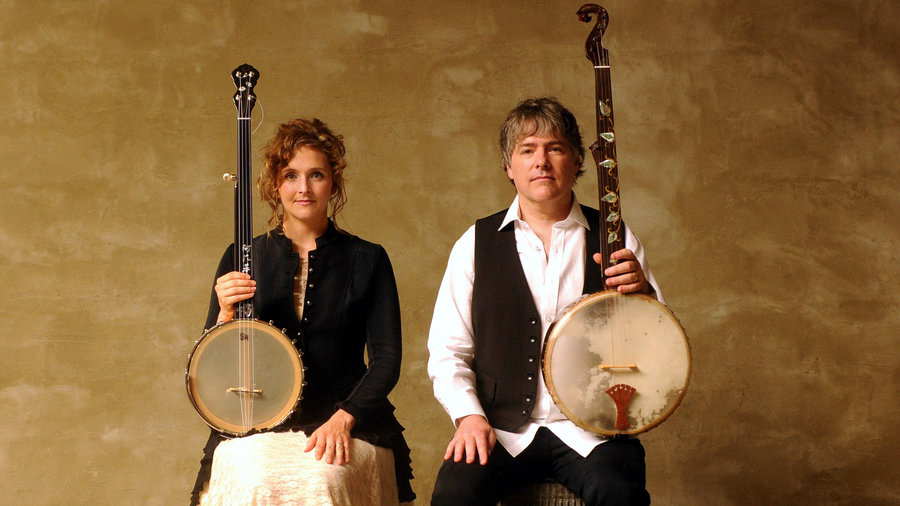
Bela Fleck, Abigail Washburn, “Echo in the Valley”

download-1One of the delightful moments is this recording is in the 5th track, when both segue into a lovely take on Bela Fleck’s “Big Country.” It’s a tune he’s presented himself a lot, most notably within the “Live from the Quick” release. It’s not as challenging as some of the things he does, which makes it a nice entrée to what he does. Moving between voices, shifting chords here and there. That all takes on an added dimension here, playing with Abigail Washburn. She’s a master of old-time banjo, he the master of everything else, and both add their separate personalities to the piece. Washburn is more poetic, Fleck more rhythmic. She’s more of a feel player, he more studied. That 5th track, a medley, is the only instrumental on the album, and too bad there aren’t a couple more. Between them they can do no wrong, of course, though this is a better release than their last one. That one, their self-titled release, felt a bit rushed in a way, maybe a album for the sake of it. It was interesting for what it was—again, these two have the reputation as being masters, and it’s a reputation that is earned—but this release, Echo in the Valley, feels more polished, maybe, more thoughtful, in a way. In all, it’s a lovely way to while away a bit of time. They are interested in opening a big piece of musical territory, and they do.

Volume Five, “Milestones”

When people who are really into wine talk about wine they don’t tend to speak in generalities, but rather a whole range of specifics. They talk about the hints of this and that, the various notes of such and such. Seeing people talk about these things on TV, it seems it’s not just descriptors. They seem to take enjoyment in all the elements of the wine as much or more as they like a wine as a whole. A wine isn’t a thing itself, but rather a collection of little things, all of which seem to deliver a little hit of appreciation or pleasure.

This new disc from Volume Five, Milestones, is much like that. There are some really great songs—“North Dakota” perhaps particularly—but it’s almost more about the parts than it is the whole. The mandolin chops are so clean, so dry, and so beautifully placed within the mix. The guitar entry to “Tell Me You’re Not Leaving” so perfect, with such a clear tone. In those things, and many more, there is a lot to love here, all of it pointing to the mastery of the musicians and the quality of the production. The content can be bleak, and there’s loads of heartbreak and bare-bones introspection on offer. The narrator in “North Dakota” says that it’s “less than you deserve, but you stay with me anyway.” The song ends with a hope to get the barley in the ground, if only to make it through another year on a farm that’s “twenty miles from either town.” The narrator of “Hayley,” has a history that is a bit murky yet clearly full of regret. There aren’t many moments of joy to go around, but maybe that’s just part and parcel of the genre (well, of course it is) and also one of the things that draw us to it.

Volume Five was named emerging artist of the year at this year’s IBMA. They’ve been at it for ten years, and have grown in that time, both as musically as well as a becoming a more cohesive group. There is a clarity of vision here, too, which buoys the quality of the work; the personality of the band is coming forward, and the members are stating that identity with more ease. For all of that, this album is easily their best to date, so to be named emerging artist after a decade of work isn’t really as wilting as it might seem. Emerging doesn’t mean new, necessarily but gaining a wider audience and a more prominent place. Indeed, Volume Five is really coming into its own, and rightly finding a place in a very busy musical marketplace. It’s certainly nice to see them gaining more attention at the IBMA. They deserve it. This album is definitely worth your attention.


Students praise Lakefield College School for Outdoor Ed program

“I thought, ‘this is the place where I could be the best version of myself.’”

for Ourkids.net

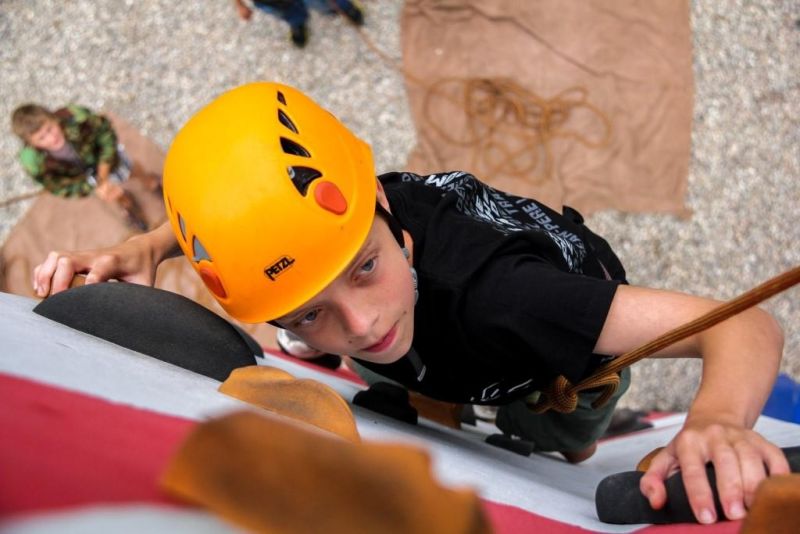
One of Betsy Macdonnell’s first glimpses of life at Lakefield College School was a grade 9 outdoor education class, one of the stops on her first tour of the campus. “I remember seeing how supportive they were with each other,” she says of the students, particularly in the case of one who was struggling with a fear of heights on the climbing wall. “Everyone was helping her to get to the top.”

What Macdonnell noticed most was what it said about the student population, and what it said about the values of the school. “I thought, ‘this is the place where I could be the best version of myself.’” She’s currently completing grade 12. Looking back over her years at LCS, she says “it was 100% the right choice.”

“ … we do it all right here … ”

LCS has long been a leader in outdoor education, in large part due to the physical assets of the campus. They include a sizeable lakefront and a vast property with trails, fields, and access to a range of green spaces. “A lot of other schools have what they call outdoor education,” says Peter Andras, Outdoor Education Coordinator and OE instructor for the past 16 years. “They are bussed up to a camp, they spend two or three days, and it’s only done in one instance, or a couple instances, throughout the year. Whereas, at Lakefield, we can integrate it into everything that we do. We have all the canoes, all the climbing stuff. We do it all right here, right on site.”

First-hand learning

That said, the reason they do it—and ultimately why outdoor education has become such a core element of the culture of the school—is because of the skills, behaviours, and values that it imparts. “We’re in the business of educating the whole person,” says Andras. “It’s not just sitting in a classroom and memorizing material. … We value relationships, and we value all of those cross-curricular ties. And everything can be integrated into outdoor ed.”

Certainly, the school does a great job of using outdoor experience—getting beyond the walls of the school—across the full breadth of the curricular offerings. Trips are taken into Algonquin park, for example, for sketching and painting the landscape, just as Tom Thomson did to create some of his most celebrated work. Like Thomson, they travel in by canoe, and stay within the landscape they are describing in their artwork.

“In physics,” says Andras, “they’re learning about estimating distances, or working through architectural problems, or trail maintenance. …. There are so many different things that you can tie together through outdoor education if you have the space to do it, and can get kids out of the classroom to do it.” Geography classes make use of the various ecosystems and landforms within the property; Phys ed classes include time on the high ropes course, and, in winter, Nordic skiing on the campus trails; biology classes make use of the various biomes on site. “It’s common to see us going outside in the trigonometry unit,” says instructor Tim Rollwagen, “with the students all focused on the ratios in triangles, finding the height of buildings and the heights of trees.”

Life lessons

Rollwagen is the Director of Global Learning, something which extends the outdoor focus of the school effectively around the world. “All of our international trips do have an extensive outdoor program,” he says. This year’s trip to Peru includes a wellness and spirituality piece, and research into Incan culture. A trip to Ecuador includes a first-hand experience of the biological diversity within the Galapagos. “Our whole school is rooted in outdoor education,” says Macdonnell, “our entire school program is based around the connection with the land.”

The feel on campus is perhaps akin to summer camp. “When they go to camp it’s almost like a second family,” says Rollwagen. “And the atmosphere at Lakefield, and the freedom that it allows, including the variety of opportunities that it has … it’s much like that. Maybe it’s even just going for a walk in the woods at the end of the day … it allows you to have this feeling of a second home.”

Decidedly, it’s a way of being that is unique to the school. “You see students coming from around the world, all different backgrounds, and suddenly they’re thrown into the middle of the woods in Canada. And its minus 20 degrees and they’re learning to use a compass, and finding their way back,” says Macdonnell, chuckling a bit as she does. She and the faculty truly appreciate how those kinds of experiences can bring students together around a new, and ultimately more positive, set of priorities.

“Kids need to get outside, and to learn to enjoy being outside,” says Andras. “In life, you have to be resilient, and to be able to rely on each other.” Those are the kinds of lessons that the environment at LCS, and the outdoor education program in particular, has been developed to provide.


This camp will change your life

Learning confidence, leadership, and life skills at Quebec’s Camp Nominingue

for OurKids.net by Glen Herbert

Not every Rhodes Scholar has been to Camp Nominingue, but at least one has. Colin Robertson got the nod last November. One of the first people he called with the news was the director of Nominingue, Grant McKenna.

That says something, as does the tattoo of the camp crest on Colin’s chest. This is a person who is not only dedicated to what camp can do, but is fully cognizant of what it has done for him. While academically he’s always been strong, he credits the camp with giving him the confidence in his talents and in himself that, ultimately, the Rhodes committee was looking for. “It’s the interpersonal skills,” says Colin. “You can’t not get along with other people at camp. … functioning as a team, understanding your role in an organization … those are the skills that you learn as a camper.”

What camp does

Colin first arrived at Nominingue as an 11-year-old camper and—as camper, LIT, and staff member—he’s been there ever since. “I was very, very shy,” he says of his first year there. “I was very unsure myself—what I enjoyed, what I wanted. It wasn’t like camp changed me over night, but every time I went back, I grew a bit more.” He’s been on staff for the past six summers, and he’ll be there again this year, just before heading off to Oxford in September.

Both Colin and his mother, Susan Fisher, are cautious about the idea that camp made Colin who he is today. It’s not quite that. Rather, they feel that camp helped him bring his skills and his personality forward, granting him the kind of confidence necessary to pursue the Rhodes, and indeed much else. Says Fisher, “What it does is that it brings the best out of you.”

Annie Duchesne’s son Simon is, in a sense, the boy that Colin was a decade ago. Simon first attended Nominingue last summer. He was a good student, but very shy. Getting him to go to camp, Duchesne admits, took a bit of cajoling. Which, actually, was also true for Colin in his first year. Fisher thought he’d be back home in two days. Eleven years later, he’s still going.

In the event, it went well. “He didn’t like it … he loved it,” says Duchesne. “He’s not the same boy now. He changed in 12 days,” the duration of his session last summer. “He’s trying things that he didn’t want to do before. He plays trombone!” she says, clearly very happily amused at the idea. “He came to me and he said ‘I want to play that instrument.’ He didn’t ask me for guitar, he asked me for slide trombone!”

For Duchesne, that’s something she didn’t see before, namely a willingness to follow his muse, with confidence and determination, and to chart his own path. “I think that’s coming from the camp. He tries everything.”

“They are all very grounded”

When asked about the benefits of the camp experience, both Fisher and Duchesne are given to talking about the kind of environment that the boys enter there. “There’s a lot of testosterone,” admits Duchesne, though she feels the nature of the camp environment—based in activity and set apart from urban life, including electronic devices—channels it in productive ways. “They are all very grounded. It’s like a big family. The kids are very courageous,” while also learning the values of teamwork and empathy.

“There are so many opportunities that allow kids to feel good about themselves,” says McKenna about what the camp environment does particularly well. “Gaining confidence and developing independence; skill building, and gaining a sense of achievement—it’s about giving kids a chance to be independent from home in a relatively safe and controlled environment. I think that that has to be what camp does the best.”

It’s also about the relationships. Says Fisher. “how often do you get to make friendships that are that long and that strong?” She admits that she doesn’t love the tattoo, though is happy that, if Colin has to have one, it’s a canoe rather than, say, a skull. She also appreciates what it means. “He just loves the camp. It’s his little place in heaven.” And that little reminder will be with him, there beneath his gowns, when he attends Oxford this fall. How great is that?

Life lessons

For OurKids.net

If there is a rock star in the world of Canadian camping, it’s Jocelyn Palm. She’s directed Glen Bernard Camp since 1977, though her leadership has extended well beyond that and has touched many, many lives along the way. She’s served as president of provincial and national camping associations, and as the first executive director of the National Lifesaving Society, and created the Women’s Health Matters Forum, in association with Women’s College Hospital. In 2013 she was invested into the Order of Canada, cited for “being an inspiration to generations of women.” Recently, as part of the #ThanksToCamp campaign, she credited all of her success to, well, camp. “Camp gave me the confidence to tackle things for myself,” she said, reflecting on when she herself was a young camper. “Camp encouraged me to find the tenacity and the gut instinct that is needed to continuously focus on the bigger picture.”

It’s a marathon, not a sprint

Today, we’d call that “grit,” a concept that has been gaining traction particularly through the work of Angela Lee- Duckworth, a lecturer in psychology at the University of Pennsylvania. She studies the intangible aspects of success: self-moderation, passion and perseverance, and a healthy approach to disappointment.

Camp Ouareau

“Grit is having stamina,” says Lee-Duckworth. “Grit is living life like it’s a marathon, not a sprint,” while acknowledging your abilities as well as your weaknesses. Her book, Grit: The Power and Passion of Perseverance, begins with a discussion of students who drop out of West Point, and that “rising to the occasion had almost nothing to do with talent.” The determinant is less ability than it is a “hang-in-there posture toward challenge.” Grit is what, ultimately, will help kids accept setbacks and weather the difficulties they’ll encounter as they grow into adulthood and beyond.

And with Palm and so many others, it’s also proven to be something that camps are uniquely able to provide. Yes, there is skill development, though typically skills aren’t promoted for themselves alone, and with more important goals in mind. “It’s great that you become, say, a skilled rock climber,” says Steve Archibald, director of Medeba Summer Camp, “but hopefully in the process of learning skills we’re extracting some things that develop our character, our leadership competencies. And they become things that are very transferrable … into our workplace, family, or community of friends. We start to see skills and ways of thinking that are very transferrable.”

Prime among them is a sense of who we are, and how we can develop our strengths and bring them to bear in positive ways. Says Palm, “Nowhere else are you given so much responsibility at a young age, held accountable, given an opportunity to make mistakes and fix them, and be supported through all that.” It can be a transformative experience. Of her own campers, Palm says that “when I ask them ‘What did you learn at camp?’, the thing I most often get is: ‘What I learned about myself.’”

Zodiac Swim and Specialty Camp

Be prepared

“These are really just foundational skills,” says Kate Cassidy, director of Brock Youth University, a program based in St. Catharines, Ontario. “Developing these skills doesn’t start at 18; it starts when they’re much younger.” They are nevertheless what employers will be looking for when the campers have grown, left camp, and begin their careers. “You can really tell in a work environment who has been to camp and who hasn’t,” says Lisa Wilson, long-time director of Camp Oconto. She chuckles as she says that, perhaps out of modest pride for helping girls over her decades as a camp professional, to achieve that difference, that character.

Wilson first attended Camp Oconto at just three months of age. Her parents ran the camp and then, after them, she ran it, and has done now for 36 years. When it comes to camping, much like Palm, she’s a lifer. She loves it, not for the office work of course—there’s lots of that, which is handled out of the Unionville office whenever they aren’t at camp—but for what camp can do in the life of a child. “I get wonderful thank-you notes and emails from different people,” she says, turning to one that she recently got from a parent in the UK. It’s about a camper who arrived many years from there, and it says many of the things that these kinds of letters typically do. How camp was so important to her, and to her family. How important the memories continue to be, despite how little of each year, when you really think about it, she was actually at camp. The letter writer describes how camp encouraged her daughter to grow and develop into the person she is today.

Maya came back from her first year at camp and… there was something so profound about the change that had happened in her… and it was partly about being more independent and more autonomous, but it was also just some sort of self-confidence … ”

–Liz Warwick, parent, Camp Ouareau

“It makes me realize how important it is to be a positive role model,” says Wilson. “That’s what keeps me going. It can be challenging, but the positive impact is huge.” What that thank-you note conspicuously lacks, as many do, is any mention of specific skill development, at least in the way we typically think of it. The take home, at the end of the summer and in the years to come, often isn’t what they did at camp, but who camp helped them to become. “So many things at camp just come through by osmosis,” says Wilson. “We’re not teaching them; they’re learning by doing.” As she speaks, she wonders if the point might be even finer than that: you’re not just learning by doing, you’re also learning by simply being there. “All the wonderful activities are great, but they’re very much a vehicle for learning some of the more important things,” including self-awareness, communication skills, problem solving, and perseverance.

Accept support …

One of the reasons that camp is so successful with young people, Wilson feels, is that there is a more realistic interface between kids and the world around them. “People on social media, they take pictures on sunny days when they’re doing fun things and it gives them unrealistic expectations of what life should be.” At camp, for example, it rains. “In the city, if it’s a rainy day, and gross, and cold, chances are you might just sit inside all day if you can get away with it. Whereas at camp you have to get out. If it’s raining, we still go out. We walk to the dining hall, or to activities, and we dance in the rain. … It may not be an enjoyment thing, it may just be something you need to get through.”

Ways of the Woods Day Camp

Another reason is because any hardships aren’t skirted, but faced head on, together. Oconto is a girls’ camp, though Wilson is careful to contextualize the benefits of a single-gender environment. “There’s girl power, there’s boy power,” she says with what feels like a sigh, “but I think we need to be careful because all youth need support.” There’s a sigh there, too, in acknowledgment that that term, “support,” can be a tricky one. For her, it isn’t synonymous with a personal cheering squad, but rather with a context in which kids can learn to accept both their successes and their failures. “To say to them that nobody is ever going to win is ridiculous,” she says, noting that competition is part of life. But it’s a fine line, of course, in presenting positive forms of competition, healthy attitudes, and appropriate rewards. At Oconto, there are a couple of trophies, though Wilson tries to keep things simpler. Success is most typically acknowledged through a pat on the back, a high-five, or a round of applause in the dining hall. “The warmth they get from that is far bigger than what they get from a trophy.”

There is the brotherhood factor—we see boys really trying to live up to the positive qualities of the older staff and older alumni.”

— Mike Sladden, Camp Pathfinder

… but carry your own pack

A story Wilson likes to tell comes from when she was at a coed tripping camp. “I walked along the portage path and there was a girl waiting there, and I asked her what she was doing. She said she was waiting for her boyfriend, because he would carry her pack.”

For Wilson, that wasn’t on. There was an ensuing conversation, the upshot being that “you don’t need somebody else to carry your pack.” While not a panacea, Wilson feels that one of the benefits of girls’ camps is that they start from that point. “The fact is that at a girls’ camp there wouldn’t be a boy to say ‘well I’m going to let him do my tough work.’”

For many kids, camp is the only place they not only have an opportunity to really be responsible for carrying their own pack, but are required to, and that’s true across the various types of camp offerings. “It’s not a cruise,” says Christy Griffin of Bytown Brigantine. They sail tall ships with fully licensed youth crew on Lake Ontario, the St. Lawrence, and the Atlantic Ocean.

Bytown Brigantine

“You’re stepping aboard as a crew member,” says Griffin. “It’s fairly rustic. There are no curling irons and no hair dryers. If you want a shower, it’s usually in the lake.” There are lots of things to do, and everyone does them. At the same time, kids learn about weather patterns, do chart work, even prep food in the galley. “It’s very much a hands-on experience.” It also isn’t for the faint of heart. Griffin recalls that one year there was a girl who was terrified of heights, and resistant to getting up into the rigging. Even so, the boat is its own world, with everyone leading by example, and within a few days, she was up there, too, getting the job done and loving it. They all do, even without their phones (devices are only available to the kids while they are in port).

One session sails from Saint John, New Brunswick to New York City, and takes in the sights and culture along the way. “They will be sailing Long Island Sound, Martha’s Vineyard, and Mystic Seaport. … In Louisburg, it’s crab fest that weekend, and we’ll be participating in a very authentic maritime event.” In port, the kids are the experts, representing the ship, its crew, and interpreting the experience aboard.

Wear good clothes, and do what you need to do

For some—as with the girl who was reluctant to climb into the rigging—the physical challenges of life aboard ship are the most consequential. For others, though, it could be the public speaking, or the need to collaborate with others. It’s a reminder that all kids need to be challenged in order to grow and learn, though they don’t all need to be challenged in the same way.

Marie-Pierre Lacasse is the director of Camp Portneuf in Lac Sept-Îles, Québec. It’s a traditional camp with a twist, in a sense, in that it focuses on supporting kids with behavioural problems. “We had a child that was on the spectrum,” she says. “He was verbal, but has a really hard time interrelating with people. … When his mom showed up at the end of the week, she said that it was the first time he had ever succeeded at something. He had actually stayed his whole week at camp,” this being a child for whom staying a full day at school was a challenge, one that he had rarely met. “That’s the kind of experience that we’re looking for. A life-impacting type of experience, for kids that typically don’t fit in,” says Lacasse. “Who hasn’t been labelled, who hasn’t been set aside? At the end of the week, we want them to have had just a regular experience.”

It doesn’t always present in the same way. Contrasting with life aboard a tall ship, Lacasse says that “if my kids want to follow ants for an hour, great! That’s an awesome activity!” Watching ants is a great activity, in her mind, not because of what kids learn about ants, but the time it gives them to slow down a bit, follow their curiosity, and support the values inherent in the camp experience. “Our campers will become staff,” says Lacasse, “they have to be empowered in their experience if they’re going to transmit the same thing to others.” Certainly, that experience of empowerment, as well as that sense of trust and responsibility, can be transformative. “These are great kids!” says Lacasse, and she lets them see that about themselves. “We want them to be in contact with the world, with each other. When I talk to parents, I talk about how they will develop at camp, not what they’re going to do at camp.”

Yes, you do learn a lot, say, by going to archery—how to use a bow and arrow, and how to be safe. But it’s not just those lessons that you’re at camp for. It’s the life lessons.”

—Nicole Christamtsis, director, Olympia Sports Camp

First eat, then sing

There are lots of rules at camp, of course, because there needs to be. Kids need to wear PFDs, and to stop running when the whistle blows. There are some, too, that you might not expect. “At lunch and dinner we have a rule that after everyone has finished a first course, then you’re allowed to sing,” says Lisa Wilson. “The first course rule is because we’d have kids leaving the dining hall without having eaten, just singing and dancing.”

Camp Glen Bernard

It highlights what a different place, a different sense of priorities, can bring out in kids. True, most parents don’t have to enforce a no singing rule. In the general course of events, sadly, kids aren’t given to spontaneous, full-throated singing. They feel their voices aren’t good enough, or are embarrassed for others to hear. But again, camp is different. At Oconto, the girls break out into chants and songs in the dining hall and everywhere else, too. It’s probably because it’s just one of those things that people do at camp, and always have. And everyone does it, so no one is the odd one out. Given that Oconto is a girls’ camp, there isn’t the sense of being watched by boys. It’s a different set of parameters that the campers, for a week or two, are living within.

It might not seem like much, given that most of the campers’ lives are spent elsewhere. But that’s deceptive. For the girls canoeing at Oconto, the kids watching the ants at Portneuf, or the kids in the rigging of a tall ship, they’re learning about who they are, what they’re capable of, and who they might become. They’re learning about the world, the values that they hold, and the opportunities that are available to them. They’re learning to trust themselves, and to trust others. “If you build up skills that are positive,” says Lacasse, “that’s awesome.” She’s right. It is. And they’re skills that they’ll rely on for the rest of their lives.

image

Welcome to Canada, Welcome to camp

(for Our Kids)

“They made me do the presentation twice,” says Tanya Springer. “[They were] gasping at each and every picture of a lake or sunset. They each had things they were most excited for. Pottery, swimming, sunrise canoe paddles … even sleeping in bunk beds.”

Springer was presenting to two families of new Canadians, the El Sajers and the Zalkhas, who had arrived from Syria the previous January by way of Lebanon. Through an interpreter and a PowerPoint presentation, Springer described a distinctly Canadian tradition: summer camp.

“I talked through the idea of camp,” she says, “from logistical—‘no, you won’t cook your own food’—to conceptual— ‘camp is a place to do things you don’t normally do … and to try activities you’ve never done before.’”

The camp concept can present a learning curve, even for those who don’t arrive at it from a first-hand experience of war. “With families coming from other parts of the world,” says Rudy Williamson, director of Camp Wenonah, “the idea of summer camp is already a foreign concept. Even the word ‘camp’ itself, if you’re coming from refugee camps, can mean something very, very different.”

For most Canadians it’s hard to imagine what these families had been through, though there were moments that hinted at it. After spending a month living in a hotel near Pearson Airport, both families had settled in Malton, Ontario. “Their dad told me that he’s never seen a place so beautiful as Malton,” says Springer. “I asked him what the best part of Malton is so far, and his answer was ‘no bombs!’”

Despite all of that, by the second showing of the PowerPoint slides, the parents were asking after the registration forms and the kids were laughing at the excitement of it all. They were going to camp.

“They were all just so full of energy”

Springer is a producer with the CBC, and she had covered the arrival of refugees in that capacity, including work on a television documentary about that hotel near the airport. “I remember being shocked at the number of children there. They were all just so full of energy—tearing up and down corridors, playing in elevators and stairwells … I remember wishing these kids had some formal programming. And things kind of progressed from there. I asked Jeff if it was possible to set aside some camper spots and he didn’t hesitate.” Jeff Bradshaw is executive director of Camp Wenonah, a camp near Bracebridge where Springer had been a camper and staff. He answered without a beat. “It was a ‘definitely.’”

Springer then turned to friends and neighbours within her Toronto community to help outfit the kids for camp: sleeping bags, duffle bags, incidentals. The needs were somewhat modest—Camp Wenonah was covering the cost of camp itself, so they only needed to cover supplies— and the effort was a very local one. When Springer talks about the supplies, she refers to them as “welcome kits.” And in the minds of those who contributed, “welcome” was truly the operative impulse. It felt less like a movement, and more like a pot luck dinner.

Campers are campers

And then, on August 29, they arrived at Wenonah. “Once you’re here,” says Williamson, “it’s pretty much an even playing field. You’re a kid at camp, and campers are campers.”

And they were. Mid-week, a day-long program was built around a series of Harry Potter-themed activities. One counsellor, playing the role of J K Rowling, was interviewed about her thoughts on camp life. “It was quite lovely,” she says in a clearly faux accent of a meeting with the student counsellors the night before. Other counsellors, dressed as Dementors, hid in the trees during a fast-paced, Potter-themed scavenger hunt.

While it’s just another day at camp, it’s easy to wonder what all of it must seem like to someone who, quite literally, has been dropped into this situation. There’s a lot of noise and activity because, well, it’s camp after all. Still, if anyone has any anxieties, it clearly isn’t the kids. They join in, off in all directions through the trees, around the cabins, skidding on the gravel pathway. One distracts a Dementor while another robs his pail of golf balls, the “eggs” that the campers are tasked to collect. It’s a clever bit of teamwork on their part, and it brings lots of smiles from campers and staff alike. If anything, what’s striking is how unremarkable it all is. The staff know very little about the children’s experience before or even after arriving in Canada, and that’s deliberate. “There’s not much recognition that these kids are any different,” says Williamson, “the staff members, obviously, aren’t making a big deal about it. We want them to be as integrated as possible.”

The campers from Syria do congregate a bit, both in the dining hall and during the activities, which is perhaps a function of their facility in English. An older teen arrived with them, a volunteer who himself is a new Canadian and who has a personal connection to the families of the campers. Still, they don’t cling to him in the way that, frankly, we might were we dropped into a situation that was as foreign to our experience as this must be to theirs.

Why camp?

Wenonah isn’t the only camp that welcomed refugees last summer—Glen Bernard Camp hosted 26 campers from Syria—and they certainly won’t be the last. For Bradshaw and Jocelyn Palm, director at Glen Bernard, offering spaces for these campers is something of a no-brainer. For the camp, it’s an opportunity to provide an example to the campers as well as those outside the camp gates: it demonstrates that we all, to varying degrees, have something to offer. It also underscores the idea that these are people, after all.

Following on, the benefits of camp are the same for those who arrive from overseas as those who arrive from more local communities. It’s not about a week or two. It’s about how we think of ourselves, and how we relate to others.

“It just lets kids be kids,” says Bradshaw.

“I was imagining these kids being uprooted from their homes, their school, their friends, and the connectedness in their lives … camp is a place where they could be connected again. To a very different group of people, for sure, but a place where they can be connected and feel a sense of belonging within a community.”

It’s clear when speaking to him that he really means that in the broadest sense. This isn’t about changing a child’s summer, but about changing a child’s life. “Our approach to camp has always been to encourage people to think about a longer commitment. We’d rather have kids there for a longer term, and we would like to engage these families over the long term. Our hope is that they will come in the years to come. One boy is older, so too old to come as a camper, but we’d like to have him in our leadership program next year. So that’s something we’re working on, and hope we can make it happen.”

“My goal is to integrate those kids into longer sessions, so they can come for a period of two weeks and be comfortable at camp. We’re looking at re-engaging those particular children first, and then broadening out from there.”

He pauses, then adds, almost apologetically, “we think we can do some good stuff with this.”

Indeed, it seems that they already have.

—by Glen Herbert

Mile Twelve’s “Onwards”


Sam Bush once said that Bill Monroe was the ultimate feel player. It’s a backhanded compliment in a way, despite Bush’s clear reverence, because what he was saying was that Monroe lacked melodic precision, playing more to rhythm. He was the father of bluegrass, true, but he was no Mike Marshall or Chris Thile. They are precise, play long runs of clear notes, and have timing like a clock. It’s fun to wonder what Monroe might think of them or, even better, bands like Mile Twelve who, well, are precise. Onwards is their second release, though feels a bit like the first, given that it’s the first full length, fully formed album. The players are young, and whippersnappers all. They met at Berklee and the New England Conservatory. It’s fun to wonder what Monroe might think of that as well, with bluegrass taking a place within musical academia alongside classical music and jazz.

But there is a delight in precision—in clear tones, rather than ancient ones—crafted with care and, dare we say it, elegance. I don’t think the band members here would use that word, but I think it’s apt. The joy within the music that these players are making derives less from the drive—though there are flashes of that—than from the beauty of the tonality and the sublime craftsmanship. Which is why, perhaps, the best moments on the album are the instrumental tracks. There are only two—“Wickwire” and “Old Tom”—but I wish there were more. The vocals aren’t yet at the level of the instrumentation, though no doubt that will come in time. Likewise, some of the narrative material jars with what we know of the musicians. The voice in “In the Shade” (“I was so much younger then/I couldn’t comprehend/the means to a brighter end/so I cast it to the side”) is unconvincing, perhaps given the delivery, but also just in the fact that we know that, with a voice sounding so young, the time frame isn’t possible, nor the wisdom supposedly gained.

Like any young band, there is a phase of playing to the influences, and I think there’s some of that here. As you might expect, they clearly have learned at the feet of the third and fourth generation players more than the first and second. “Old Tom” recalls Nickel Creek’s “Ode to a Butterfly, “In the Shade” recalls the Punch Brothers, with the shifts in rhythm and vocal register. There are flashes of earlier influences, and there’s a bit of Del McCoury’s in “The Sunny Side of Town.”

They do it so well, but, perhaps again like any young band, it feels like they haven’t yet found their own voice and are casting about a bit.  The unit is so strong, so studied, so clearly aware of all aspects of the genre. In addition to the instrumental pieces, standouts include “Call My Soul” and “You Don’t Even Know It Yet.” This album is a true debut for the band, and given where they’re starting from, it will be very interesting to see where they go and what they get up to. Certainly, this is a band to keep an eye on.


Navigating the gap year

Neuchâtel Junior College

(for OurKids.net) At its simplest, a gap year is a non-academic year between high school graduation and enrollment at university. It’s becoming more common, and more structured, though the vast majority of Canadian parents didn’t take a gap year. Because of that lack of first-person experience, misconceptions abound. The fear is that it’s a year off, with the only goal being to have a good time and experience some newfound freedom at the parents’ expense.

Occasionally, those misconceptions may be somewhat apt. In some instances, a gap year is simply a decision made by default: a student doesn’t know what to study at university, or would like to go on a year-long travel party. As such, it’s a “gap” in the truest sense of the term: a break in learning, disrupting the development from high school into post-secondary work.

Not a break from learning, but a continuation of it. 

Parents rightly frown on those motives despite the fact that, even then, the time away from school can prove useful and motivating. If a student truly doesn’t know what he or she would like to study after high school, then taking the time to consider options is far better for all involved than simply enrolling at university as the default. Given the costs of tuition, as well as academic competition, university is not the place to be finding yourself or trying new interests on for size, something that the stats demonstrate. Each year 38% of students drop out of university or change majors, delaying or obviating graduation. That’s a big number. It’s easy to wonder if it would be as high if more students saw a gap year as a viable option. It might delay graduation by a year, though not always. In some cases, it could mean the difference between completing a university degree and, well, not.

That said, the best use of a gap year is one that isn’t just a break, but augments the student’s high school career. Princeton University describes its program as a “bridge year,” this to highlight the continuum of a student’s intellectual and academic path. Some schools in Canada offer bridge programs, though they don’t always deploy the term in the same way; bridging programs at York University, for example, are designed to prepare students for success at university, such as mature students, international students, or those arriving from community college. The University of Alberta uses the term specifically in reference to international students, where their bridging program intends to build the requisite language skills in students for who English is a second language.

The best case

Whatever term we use, the best gap year plan is one that puts parents and university admissions officers’ minds at ease. This would be it: a student applies for university entrance at the end of high school, gains admission, then requests deferral and submitting a plan for how they intend to spend it. The plan is concrete, listing real plans, and participation in accredited programs that reflect the student’s interests and course of study. Then, the university grants the deferral, and all is well. It’s a common model in Europe, where gap programs began in the 1960s, and is increasingly common in the US. Harvard, for example, suggests that students defer their acceptance for a year in order to gain some real-world experience. The Yale University office of carreer strategy notes that “short-term experiences can help students explore career paths and gain experience and credentials.” They also outline some of the things they feel make for a productive use of the time.

All of that is an indication of how central the gap year experience is becoming to student success in North America. While deferring university entrance is less common in Canada than elsewhere, that is changing, too. At many Canadian private schools between 7 and 10% of graduates will defer university acceptances in order to take a gap year.

The next best case

The more common model in Canada at the moment is when a student creates a plan for their gap year, one that is sound, and which allows them to further explore their academic interests. Then they apply to post-secondary programs at the completion of the year.

Not an extended beach vacation, but travel in order to gain a sense of the world and their place within it.

What a university admission officer will want to see is that the time has been used productively, and that students have used it to add value to their application. A well-spent year will be one that has been challenging, allowing students to explore their place in the world, interact authentically with others, and foster academic and social maturity.

Class Afloat – West Island College International

Why it’s important 

Employers look very favourably on university graduates who have taken a gap year that is relevant to their course of study. It demonstrates self-determination and dedication to the content of their studies, and travel can suggest a real-world experience with international communication. “The biggest problem for student’s post-graduation when they’re applying for jobs,” says Lauren Friese, a career consultant, “is that they all look like clones; there’s not a lot to differentiate business grad one from business grad two, or sociology grad one from sociology grad two. Taking the initiative to work with a charity, or travel the world or whatever it is, those things stand out.”

That said, it’s alright to be selfish. Sailing around the world seems like an adventure of a lifetime, and it is. It’s also one of those things that, if you don’t do it now, you likely never will. When Alexandra Moore heard about the Class Afloat program, she decided to seize the day. Just finishing high school, Alexandra had sailed on a tall ship before and thought that West Island’s program would allow her to see the world.

Jane Ritcey, Alexandra’s mother, took a bit of convincing, though now agrees that the expeirence was an important one. “She certainly has a deeper understanding and appreciation of the world,” says Ritcey. “They have seen everything from palaces to poverty.”

While Alexandra had always been independent, according to Ritcey, she’s become even more responsible and team-oriented after her time on the ship, where everybody is expected to pull their weight and watch out for others, both on land and off. During her travels, Alexandra also decided what she wants to do with the next stage of her life.

How to spend a gap year

International volunteer programs

Making money, especially when facing university enrollment, is always a good idea. That said, a gap year spent only making money—taking a local 9 to 5 job doing something unrelated to their future goals, say—isn’t always, or perhaps ever, the best use of the year. It will help with payments, perhaps, but better would be engaging in activities that will help a student gain insight into who they are, what they’d like to persue, and help build their resume toward that end. Volunteering abroad meets all of those goals and then some, often at low cost to the student, which is why it has long been the most popular gap-year activity.

The volunteering options are vast, as are the means of acquiring them. Some organizations recruit international volunteers in Canada, while others are organized once a student arrives in the destination country. ECO Volunteer UP, for example, offers programs in Ecuador, ranging from working with street children in Quito, or travelling to the countryside to work in a farming community. Travel to and from Ecuador isn’t covered, and there is a fee for administration, but otherwise room and board and local transportation are provided.

Domestic volunteer programs

Staying in Canada for a volunteer placement may not sound as exotic as going to Africa or Ecuador, though it can be just as rewarding, if not more so. Because it is within a student’s home country, it can also be more meaningful, and lead more readily to connections within a career path later on.

Cultural immersion programs

There can be quite a bit of grey area between volunteering and cultural immersion programs, so much so that it’s perhaps all grey area. Volunteer Nepal, for example, places volunteers within poverty stricken communities, helping with daily life and the administration of health care. Getting to Nepal is a journey unto itself, and the experience wtihin the community is a great entrée into issues of population health. The program is augmented by living within the community, we well as trekking and rafting trips, among other things, to allow a bit of fun while interacting with like-minded peers from around the world.

Not a tour of museums and cathedrals, but opportunities to engage with others, authentically experiencing the challenges of international communication.

Academic programs

Just as there can be significant grey area between volunteer and culture programs, so too between academic and non-academic programs. The term post-graduate year is primarily used in reference to academic programs, such as that offered at Ridley College in Ontario. Commonly known as the “victory lap,” a post-graduate year is a fifth year of high school courses, intended to take courses and raise marks in order to strengthen a university application. Robert Land Academy offers a similar option, if in a more ordered setting.

Gap years, in contrast, are more typically chosen in order to get away from classroom academics, and to gain experience prior to entering university, though some programs offer a little bit of both. Class Afloat, for example, accepts graduates on board their sailing programs, though all participants also enroll in courses for credit.

Ridley College

Language immersion programs

Fulford Academy in Brockville, Ontario offers international students a gap year program to master their English skills before moving on to a North American boarding school or university. Students work on mastering English through English fundamentals and credit support classes. Fulford Academy also prepares its students for life in Canada with frequent evening and weekend excursions. “It’s not just an ESL curriculum; they focus on the cultural integration, too,” says Anna Galanta, admissions director at Appleby College in Oakville, Ontario. “The Fulford grads are well-prepared when they get here.”

Similarly there are French language programs that, as with the English counterparts, offer full linguistic and cultural immersion. The benefits can be utilitarian, such as preparing for study in a French-language environment, as well as personal, affording insight into the linguistic and cultural diversity of the nation. Some, such as the YMCA International Language School Gap Year Program run out of LaSalle College in Montreal, attracts participants from across Canada around the world, allowing for a strikingly international experience.

Resources and programs:

Canada World Youth

World University Service of Canada

Education First

CUSO International

My Gap Year

Study and Go Abroad

Global Leadership Academy

Thinking Beyond Borders

Projects Abroad

World University Service of Canada 

Gap Work


Students praise LCS outdoor education program

By Glen Herbert for OurKids.net

One of Betsy Macdonnell’s first glimpses of life at Lakefield College School was a grade 9 outdoor education class, one of the stops on her first tour of the campus. “I remember seeing how supportive they were with each other,” she says of the students, particularly in the case of one who was struggling with a fear of heights on the climbing wall. “Everyone was helping her to get to the top.”

What Macdonnell noticed most was what it said about the student population, and what it said about the values of the school. “I thought, ‘this is the place where I could be the best version of myself.’” She’s currently completing grade 12. Looking back over her years at LCS, she says “it was 100% the right choice.”

“ … we do it all right here … ”

LCS has long been a leader in outdoor education, in large part due to the physical assets of the campus. They include a sizeable lakefront and a vast property with trails, fields, and access to a range of green spaces. “A lot of other schools have what they call outdoor education,” says Peter Andras, Outdoor Education Coordinator and OE instructor for the past 16 years. “They are bussed up to a camp, they spend two or three days, and it’s only done in one instance, or a couple instances, throughout the year. Whereas, at Lakefield, we can integrate it into everything that we do. We have all the canoes, all the climbing stuff. We do it all right here, right on site.”

First-hand learning

That said, the reason they do it—and ultimately why outdoor education has become such a core element of the culture of the school—is because of the skills, behaviours, and values that it imparts. “We’re in the business of educating the whole person,” says Andras. “It’s not just sitting in a classroom and memorizing material. … We value relationships, and we value all of those cross-curricular ties. And everything can be integrated into outdoor ed.”

Certainly, the school does a great job of using outdoor experience—getting beyond the walls of the school—across the full breadth of the curricular offerings. Trips are taken into Algonquin park, for example, for sketching and painting the landscape, just as Tom Thomson did to create some of his most celebrated work. Like Thomson, they travel in by canoe, and stay within the landscape they are describing in their artwork.

“In physics,” says Andras, “they’re learning about estimating distances, or working through architectural problems, or trail maintenance. …. There are so many different things that you can tie together through outdoor education if you have the space to do it, and can get kids out of the classroom to do it.” Geography classes make use of the various ecosystems and landforms within the property; Phys ed classes include time on the high ropes course, and, in winter, Nordic skiing on the campus trails; biology classes make use of the various biomes on site. “It’s common to see us going outside in the trigonometry unit,” says instructor Tim Rollwagen, “with the students all focused on the ratios in triangles, finding the height of buildings and the heights of trees.”

Life lessons

Rollwagen is the Director of Global Learning, something which extends the outdoor focus of the school effectively around the world. “All of our international trips do have an extensive outdoor program,” he says. This year’s trip to Peru includes a wellness and spirituality piece, and research into Incan culture. A trip to Ecuador includes a first-hand experience of the biological diversity within the Galapagos. “Our whole school is rooted in outdoor education,” says Macdonnell, “our entire school program is based around the connection with the land.”

The feel on campus is perhaps akin to summer camp. “When they go to camp it’s almost like a second family,” says Rollwagen. “And the atmosphere at Lakefield, and the freedom that it allows, including the variety of opportunities that it has … it’s much like that. Maybe it’s even just going for a walk in the woods at the end of the day … it allows you to have this feeling of a second home.”

Decidedly, it’s a way of being that is unique to the school. “You see students coming from around the world, all different backgrounds, and suddenly they’re thrown into the middle of the woods in Canada. And its minus 20 degrees and they’re learning to use a compass, and finding their way back,” says Macdonnell, chuckling a bit as she does. She and the faculty truly appreciate how those kinds of experiences can bring students together around a new, and ultimately more positive, set of priorities.

“Kids need to get outside, and to learn to enjoy being outside,” says Andras. “In life, you have to be resilient, and to be able to rely on each other.” Those are the kinds of lessons that the environment at LCS, and the outdoor education program in particular, has been developed to provide.

Jim Kweskin and Geoff Muldaur, “Penny’s Farm”

You’ll be forgiven if you groan a bit when you see the track listing of this new release from Jim Kweskin and Geoff Muldaur, “Penny’s Farm.” Like right there. Did you breathe out a bit, an almost imperceptible sigh, just then when I typed “Penny’s Farm”? Did you have flashbacks of John Cohen talking about how Dylan took “Penny’s Farm” from the Harry Smith anthology and turned it into “Maggie’s Farm”? When you read Geoff Muldaur, did you think of Maria, and her marriage to Geoff? And all those rehashes of the basket houses, and the tour busses, and the black and white clip of Maria, newly single, swaying with Jim Kweskin at the Bitter End, or the Gaslight, or whatever it was.

These are names and songs that have a lot of miles on them, and lots of stories attached to them, too. And, yes, it can take a bit of effort to push play on the mail-order gramophone. But, actually, you really should. Just put all that stuff away, put down the CD cover, and forget all the names and the miles. Try to listen to all of these songs as if for the first time. Because it’s absolutely worth any effort you can give it, though it doesn’t take all that much really. You’ll soon be reminded why you remember all that stuff in the first place. These are just fantastic songs. They’re like children’s stories, and they make children out of all of us. Tell me again about how my good wife will catch more fish than me. And how you played cards in Spain. And how Frankie shot her man. There she is, still wearing the kimono. Yes, it certainly is a little while to be here and a long time to be gone. I know exactly what you mean.

Truly, there’s a lot to love on this release. The guitar work is great, and the arrangements are simple, charming, and superb. They’re joined by Cindy Cashdollar and Suzy Thompson. As my daughter would say: I know, right? Yes, I know.

There are lots of memories, though the repetition is nice too. After all, that’s one of the reasons we like this stuff to begin with. The stories remind us where we are, and where we came from, even if it’s Toronto and we never ever did get around to fishing for catfish in the old fishing hole, truth be told. But it’s the idea, and the familiarity, that we love. And that picture on the cover? With the shack and the chickens? If you squint a bit, and turn a bit to the side, doesn’t it look a lot like home? I think it does. It really does.

Courtney Marie Andrews’ “Honest Life”

This is a brilliant release in all kinds of ways. Musicianship, arrangement, recording. Each one of those is wonderfully on display. It’s there in the details, such as the strings entering on “Only in My Mind,” and then the pizzicato, or the way she sings the word “Barcelona.” There are harmonies added to isolated phrases that make you think, wow, that’s brilliant. So beautiful in themselves, but also so delightful in the level skill that they belie, and the way they help support and propel the narrative.

The writing is the thing that stands out, even given the quality of the setting and the skill. Ask anyone about writing songs and, more often than not, they’ll say something about a hook. But a hook isn’t songwriting, it’s marketing. Selling something. Writing, good writing, tells something. Though it’s even more than that. There’s a pleasure that comes from finding the structures-, in realizing the care and the complexity that went into crafting these pieces. There’s a delight that comes from seeing something that is just so brilliantly constructed. (Have you listened to Lightfoot’s “Great Canadian Railroad Trilogy” recently? It’s as much a marvel as it ever was.)

The first track, “Rookie Dreaming,” sneaks in, and just when you’re doubting it, it delights you. Before we get to the confessional voice—“I was movin’ too fast ” etc.—she’s already broadening the narrative, gesturing to a universal: “I was singing with the choir on the train/I was a traveling man/I did not yet have a name/I was a 1960s movie/I was a one-night love story.” Certainly, that’s the thing about confessional songwriting. It’s not about grabbing a guitar and telling us about your day. It might sound like that. “The wind is in from Africa/last night I couldn’t sleep … “ But it’s not. Andrews clearly knows that.

She often has the diction of Joni Mitchell, the full vowels and clipped Rs and Ts. She adds her own harmonies, as Mitchell did, and adds similar ornaments, uses similar phrasing. Most importantly, of course, is a similar attention to narrative. Like Mitchell, it might sound like she’s telling you about what happened last week, as in “Table for One” when she sings “Table for one/I’ve got no one I’m waiting on/I just pulled into town an hour ago/from the streets of Houston/to this diner in Ohio.” But she’s not, and it’s the idea that comes to mind, not the details. By the end of album, we don’t know her any more than we did at the beginning. Because it’s not about her. It’s about us.

I know that music isn’t a race, but if this album doesn’t win some awards this year, I don’t know what.

The Bankesters “Nightbird”

The Bankesters are a family band, and that fact–remember Cherryholmes?–can lead to a bit of head scratching. How? How is it possible that a family can all get together, each holding up his or her instrumental end of the bargain? But they do. Cherryholmes certainly did, and the Bankesters are coming up close to that.

This latest release is, unsurprisingly, their best so far, though they’ve had some success prior. In 2013 they released Love has Wheels which included “Cups (When I’m Gone)” which became something of a hit. The song is a version, two or three generations along, of the Carter’s “Will You Miss Me When I’m Gone,” in a version made famous by a pop band and covered by Anna Kendrick for the soundtrack of the film Pitch Perfect. I love that the Bankesters did it. In a sense their version–by young people who have feet in both the pop and bluegrass world–closes a circle. (Get it … the circle is unbroken …. )

In any case, this album continues the great work that they’ve been doing of late. They’re now at the point that writers and emcees need to include “family band” whenever they talk about them (though, yes, I’ve done it twice already here). They are operating as a professional unit, with a strong, confident stage presence, and that translates well to the recording studio, especially on this disc.

Nightbird is their third with Compass, and their third produced by Alison Brown. She knows what she’s doing, of course, and it shows. There are some other Compass artists appearing here–Sierra Hull, Josh Williams, Rob Ickes–and it’s a happy marriage of talents in all cases.

There’s a nice range of moods and arrangement across the disc, despite perhaps some soft spots here and there. Vocally the unit is best when it sticks with the daughters out front, as on “For Every Valley (There’s a Mountain)” and the title track, “Nightbird.” Otherwise the songwriting doesn’t perhaps jump up and grab you, but, a few listens in, that will change.

Did I mention that they’re a family band? … yup … it’s a puzzler …

Making moonshine with Roger Lee “Buck” Nance

 by Glen Herbert

“Listen,” says Nance. “It sounds like rain on a roof.” And it really does. Large vats line the room, each filled with a roiling mixture of grain and yeast. The gas being released as bubbles is responsible for the sound and the smell, which is somewhere between beer and bread and turpentine.

5500816b00316-1.image
On the right is Buck Nance standing next to one of the tanks that he made by hand. A professional welder, he made everything within the distillery by hand–tanks, pipes, coils–with the exception of the furnace directly behind him.

It’s an attractive facility, miles away conceptually and physically from the clandestine stills that come to mind whenever we think of moonshine. The Copper Barrel Distillery is a boutique on par with the micro-wineries of the Napa Valley. The building, once home to a furniture manufacturer, has been restored to bring out its character as well as its heritage. The idea behind the distillery itself is  built on those concepts as well: character and heritage.

After striking up a conversation which Roger Lee “Buck” Nance in the showroom, he pulled us aside, asking in a hushed tone if we’d like to see the machinery. While the operation is entirely legal, operating under a complex mesh of regulations and licenses, for most of his life, Nance has lived somewhere outside of the law, or at least on the fringes of it. He knew Junior Johnson and had a hand in some of the white liquor (he doesn’t call it moonshine in conversation, rather white liquor or corn liquor or just shine) that Johnson transported came from Nance’s stills or those he tended while he was learning the craft.

And while we might be attracted to the outlaw side of the tradition, for Nance, it’s about the craft. He’s part of a folk tradition, one that by necessity was passed orally, secretively, from one moonshiner to the next, and which continues to focus his attention. He’s proud of that tradition, and guards it even now. Standing next to the fermenters, it’s that pride that shows, not just in the recipe, but in the process, and his place as a recipient of the knowledge needed to drive it forward and, perhaps, pass it along.

Certainly, it’s moonshine, and the traditions that surround it that have largely defined Nance’s life. The first thing he’s known for is a bust in 2009, one which netted 929 gallons of white liquor for the authorities—the product of two months of investigation—and linked Nance’s name to the largest moonshine bust in North Carolina history.

Unknown-2When he wasn’t off in the hills, Nance was a welder, and his knowledge of metal is probably on par with his knowledge of moonshine. Most of the stainless he uses is 301, some of it 302, whatever that means. The last tank in the process before bottling has two large copper coils within it, and Nance tells us to get up on the ladder in order to take a look. They don’t look anything like what you have in mind when you think of a still. They’re clean, perfect, set within a clear vat of stainless steel.

Near the spout that the finished product is drawn from is a small glass jar with a length of copper wire twisted around its neck to create a handle. Nance uses the jar—its one he’s had for decades apparently—to gauge proof. “They came with their equipment, you know, and took some samples,” Nance says of the regulators tasked with granting a license to the outfit. He talks with a broad accent, like he’s got a mouth full of marbles. “I told them that it was 142, and I was right. And that’s a true story. He told me that if they ever need to calibrate the equipment, they’ll come to me.” He demurs, knowing that it sounds a bit like a fish story. “But that’s the truth. I can tell by the bubbles. How big they are, how fast they move.” And he can.

“Feel that heat? That’s how we heat the room. There’s no heating or air conditioning in here. We brought these in here [two large plastic containers filled with the waste product of fermentation] to keep it warm when it gets cold like it did last night.” The waste material is given to local farmers to feed to stock, as it’s a rich source of protein and nutrients. A local rancher feeds it to his beef cattle, says Nance, and some of that beef finds its way back as a thank you.

It’s easy to think first of the lawlessness of moonshine, and for anyone living beyond the regions in which it has been made for generations, that’s not just the first thing, but the only thing, they are likely to know about it. But there’s a story here, and it’s not about drunkenness, or violence, or fast cars. Perhaps it has been a fine line, at least since the 1920s and the enactment of Prohibition, but it’s what’s on the other side of that line that appeals to Nance. For him, white liquor is a symbol of autonomy. It’s a link to the past, with the recipes and practices honed through trial and error, passed along by word of mouth. And, as odd as this might seem to people who haven’t experienced it directly, it’s about community. The basket outside the door, the barter of this for that. Through those things—and certainly there are many in the region who have jars that they’ve received that they’ve never opened—it’s perhaps less about the product than it is an awareness of place, and people, and a connection to the past as well as those who are with us, here, now.

We’re here. Get used to it.

(for CBC Kids)

Steve Colbert once said that stay-at-home dads are “against nature’s laws.” Your grandmother probably thinks that, too.

The world that we know today is, of course, different than that of yesteryear. People don’t smoke in hospitals, and the moon is no longer a very interesting destination; it’s illegal to strike a dog, or a child, or a match on an airplane. In all, we don’t live in Mayberry anymore, and we can chalk that up to social change, mostly of the good kind.

Still, as long as there are Hooters restaurants and bowling leagues, there will be pockets of our culture that remain relatively untouched by the advances of the day. Parenting is one of them. Step out with an infant and you step into a world where old stereotypes and habits die hard and where gender roles retain a good whiff of the 1950s.

At the playgroups, mommies’ groups, in the parks and the libraries, by and large the women are still doing it by themselves. Whether out of fear, peer pressure or just having other things to do, men aren’t.

Of course, there is progress. Now we think “Involved Dad.” (We don’t say, “Mr. Mom” anymore.) After all, statistics show that the rate of paternity leave has jumped 60 per cent since 2004, although a mere five per cent of fathers are not working while the mother is employed. The statistics are silent on which of these fathers are jobless by choice. Apparently 60 per cent of not very many is still not very many. Which means that if you are Involved Dad, you’re on your own. You’re also likely unemployed.

Dads out and about
When I recently took time off to care for my son, James, I didn’t know any of that and neither did my neighbour, Brad. Like me, he decided (read: wife runs own business and makes more money than he does) to take time off to care for his newborn (read: we were both doing what we were told).

It was spring and we strapped our respective infants on our respective backs (my backpack is the upgrade; his is the one that didn’t test as well) and set off for lunch downtown. We were feeling pretty good about things, and why shouldn’t we? Out and about with the fruit of our loins and all that. “Look at us,” we thought, “we’re Involved Dads!”

No sooner were we in the door of the restaurant when the snickering and the glances began. The hostess wasn’t much help, either. “Where are your wives?!” she asked, roughly with the force of a sneeze. Her reaction, part confusion and part hilarity, took a bit of wind out of our sails, if you get my meaning.

We’re here! Get used to us!
The reality is that guys with babies in the middle of the week and with no women in sight isn’t quite enough to stop traffic, but it’s close. At the Legion we got a round of applause, which was maybe surprising, given whatever you might otherwise think of the Legion. Middle-aged women swarmed us at a restaurant. “You guys are awesome!” one said. “My husband didn’t even change a diaper!” said another to a round of knowing nods. There, and everywhere else we went, people seemed to have something to say, with many of the comments falling within some predictable categories. The unsupported, bitter moms: “It’s about time!” The doubters: “You don’t do this every day, do you?” Those who vote conservative: “Now I think I’ve seen it all!” The retired school teachers: “I think this is great!”

You think I’m exaggerating, but I’m not. This is the world you and I both live in. People notice and remark because you are noticeable and remarkable. And there’s a reason: women don’t think you are capable of doing this and men wonder why you would try.

The Bottom Line
Ultimately, being Involved Dad is like going off on a peacekeeping mission or installing a ceiling fan: it takes courage and fortitude, but that’s no excuse for not doing it. In time, and probably sooner than we think, people will look back – I’m utterly convinced of this – and wonder why men didn’t do it more. When they do, we’ll be able to gloat a little, noting that we were ahead of the pack. That’s something. And, by pitching in, we’re also taking time with our children that we will cherish – I’m convinced of this, too – for the rest of our lives. Of course, some days we think that maybe we really should be somewhere else, and that perhaps there is something we could be doing that is better suited to our skill sets. But there’s a conventional wisdom here that’s worth repeating: When the chips are ready to be counted, we probably won’t wish that we had worked more, made more money or impressed more strangers. We’ll wish we had spent more time with our children and that there were more giggles to coax with tickles or smiles. Sadly, it isn’t forever, so we’re right to grab the opportunity while we have the chance.

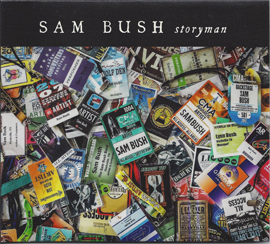
Sam Bush’s, “Storyman”

(Published by Hudson Valley Bluegrass)

sam-bush-s-270Sam Bush is such a perennial of Americana music, from first gaining lots of attention with Newgrass Revival, going on to be the King of Telluride, and he’s just kept on going. Through it all, subtle is not something that anyone might readily claim of him, what with his mullet bobbing in time while chopping on stage.

That said, it’s always been clear that Bush is far more than his stage presence might suggest. He’s played on countless recordings, and is a master of many things, prime being an ability to apply himself to the music at hand. He can play quiet. Publicly, and on his own albums, he’s more inclined to be louder, and that’s true on this one as well.

On Storyman, this latest and long-in-coming release, he’s joined by a raft of greats, with whom he’s also had a very long association. They all co-wrote the songs here, even—as with Emmylou Harris—if they aren’t known as writers themselves.

Nevertheless, those associations are what make the album really work. These are all people really working at the top of their field. Likewise, it’s not a guest-based album of the kind we typically see—i.e., greats joining in to bolster the profile of a project. Here, these are people that Bush knows well, and has done for decades. The result is playful, interesting, and warm. Bush has nothing to prove, and that’s certainly on display here, making songs like “Bowling Green” really, um, sing. That’s his hometown, and the tobacco fields, the tunes, the history feels genuine. Because, of course, it is.

There are guest vocalists here, for the most part adding harmony, but the core band is the one that Bush has toured with recently. Truly a cabal of whippersnappers if ever there was one. Scott Vestal shines, as always, on banjo. Some of the arrangements sound a bit dated, harkening back to the kind of things he was doing in the late 80s and early 90s, such as the Reggae arrangement on “Everything is Possible.” I’m still not entirely convinced that it’s truly new. But, he says it is, so I guess he would know.

This album isn’t likely to bring many new listeners, but for those of us who have been interested in everything he’s done, it’s nice to have something new. “Transcendental Meditation Blues” is a standout, as is the ballad “Lefty’s Song,” featuring Allison Krauss.

Bush will no doubt be touring the ass out of these tunes this summer. Fair enough. Nothing here to bump “Howlin’ at the Moon,” from the set list, but it will add some welcome variety. And, you know, it’s Sam Bush after all.

Arnie Naiman’s, “My Lucky Stars”

Published in Penguin Eggs, Issue #71, Fall 2016

my-lucky-stars-coverYou’ve got to love this album, and I’ll tell you why. Look at the liner notes. Each song lists the people that join Naiman, adding their stuff to his. Chris Coole’s there pretty much on every one. Love that. Naiman is credited on every track, less because he’s there than because he wants us to know which banjo he played: Vega Tubaphone, Romero. Love that! Honestly, gives your heart a bit of a thrill at every mention. Then, right after the banjo, there’s the tuning he used. Love that!!!

The reason why I love all of this, and why you should, too, is because Naiman himself so clearly loves it. There’s no other reason. He’s from Toronto. That says something. No, there’s no money in the banjo, and if you live in Toronto, it’s not cool either. If not for a very deep love, this wouldn’t be here at all. He loves clawhammer banjo—its tone, the tunes, the lilt—and it shows.

He wants to share it. And he does, quietly, carefully, and as comfortably as an old shoe. This is a beautiful, thoughtful, glorious collection of tunes that we can get lost in, precisely because Naiman does. Love it, love it, love it.

Dave Pomfret’s, A Devil’s Urge

screen-shot-2016-12-21-at-1-35-59-pmI’m forever being impressed with the level, variety, and quality of music coming out of Hamilton. The city doesn’t have the reputation of Cape Breton or Nashville, New Orleans or Muscle Shoals, and one reason might be because there isn’t just one genre of music being produced, but so many. So, too, that the blues people, for example, don’t know what’s happening in the bluegrass or fingerstyle guitar community. But the recent unearthing of a long lost Gordon Lightfoot recording at a Hamilton studio is telling, in a way. The Band signed their first contract here, just as it gave rise to Daniel Lanois. Today it’s the home—bet you didn’t know this one—of Emory Lester, one of the foremost bluegrass mandolin players in the world. We tend to look at locals and think, “well, she’s pretty good for here.” But Alfie Smith is great for anywhere. And he lives here. And on and on it goes. Hamilton, when you really get down to it, is an embarrassment of musical riches, in spite of the fact that so few seem to really think of it that way.

This latest release, A Devil’s Urge, from Dave Pomfret only supports the point. I worry that people might hear this and think, “yes, he’s good, you know, for here.” But if it wasn’t clear before, he’s good for anywhere. (Musically anyway. As a graphic artist … um … let’s say, given the cover art here, his desire exceeds his grasp.)

He clearly is willing to take some risks, and they pay off. The horn parts that bring in “Ballad of the Body Building Bandit,” set an aggressive tone for the album, and underscores the intention to work beyond the tried and true rock format. There’s some clarinet in here, too. Nice.

The stories that he tells perhaps don’t stray as far, and the writing sticks close to the typical rock themes: failed relationships, trouble, and regrets. The tune “Bury the Hatchet” takes it into overly aggressive territory—he sings, “I’ll bury the hatchet, as long as I can bury you too”—and it perhaps backfires a bit. It’s a revenge song, but it edges into psychokiller territory. Maybe she was better without him, one starts to think. Just saying. It might just be a safety issue.

Where the album really shines is in the richness of the production, and there’s an impressive cast that have lent their skills to the project. They bring a lot of grit and depth, while also opening up some space on the ballads, as on “Maybe It’s Me” and “She Can’t Smile Anymore.”

From top to bottom, there’s a lot to like. I only worry that the album won’t gain the kind of legs that it should. Because it deserves an audience, one beyond the city limits. I hope that it finds it.

Martin Harley and Daniel Kimbro, “Live at Southern Ground”


This isn’t a live album in the way that you think: it’s live in the sense of two musicians playing together, no overdubs or added tracks. There’s less audience noise than you’d expect from a live album, as in none at all. There’s more effect than we’d expect to hear on a live album, at least one that wasn’t recorded in the 80s. They say that it was recorded in a “handful of hours” within a single day. Um. Okay. I’m not sure why it matters one way or the other. It’s not a race, but if you need a stopwatch, fair enough.

Martin Harley is a dobro player, and he has the kind of voice we’d associate with the Avett Brothers, were we inclined to do so. Thin, forward, requiring a pretty face to come out of. Daniel Kimbro plays bass and adds a strikingly sympathetic backing vocal.

So, yes, there’s a bit of bravado here, though it doesn’t take long to really get on board. Harley’s playing is delicate, tasteful, and beautifully rich, restrained even when he ventures into rocking-out territory. Kimbro’s bass is gorgeous and full. At times be bows it, which is a nice touch. Between that and the vocals, there are moments when it feels like someone else has stepped into the mix, but they haven’t. It’s just the two guys, and their ability to move between moods and feels is a testament to the quality of the arrangements.

There are some covers here, including a slow take on Leadbelly’s “Goodnight Irene.” It’s like a porch swing on a hot summer’s day. Bees buzzing, all of that. It’s lovely. There’s also a lovely take on Tom Waits’ “Chocolate Jesus.” As such, Harley and Kimbro make some connections that are as welcome as they are surprising. “Automatic Life” is one of those songs that you can get stuck on in the car, which is a great place to listen to this album. It’s a great accompaniment to staring at the horizon, thinking about where you’ve been and where you’re going. And then the song ends and you remember that you haven’t got a clue.

Joe Ely, “Panhandle Rambler”


The panhandle of the title is the Texan one, not the Floridian, and the album comprises a something of a tour of the writers and the styles that we associate with the singer/songwriter culture of Texas. All but two of the songs are written by Ely, though they reference many others, including Roy Orbison, Waylon Jennings, and Guy Clark. There are two covers, a nice take on Clark’s “Magdalene” and Butch Hancock’s “When the Nights Are Cold.” Ely doesn’t bring anything particularly new to either, and both serve as reminders of how great the originals were. Which, perhaps, is partially the intent.

Ely has spent the bulk of his career straddling the folk/country/rock divides, such as they are. In 1972 he founded The Flatlanders with Jimmy Dale Gilmore and Butch Hancock, though the band was short lived. Their “Dallas” was meant to be a hit, though it wasn’t. (It’s puzzling that it didn’t catch on a bit more, actually.) Some sessions from 1972 weren’t released until 1991, and then bearing a title that is as good a précis of the band’s career you could ever hope to find: “More a Legend than a Band.”

Commercial success is fickle, of course, and whatever opportunities the Flatlanders were unable to make something of, on breaking up the members went on to find success as solo acts. Given the focus of their individual careers—Hancock tends to gravitate to folk music, and Gilmore to country—it’s easy to wonder if the Flatlanders suffered a crisis of identity more than anything else, with each member pulling in different directions.

Certainly, a more complex place than we might be prone to give it credit for. Ely has said that he was surprised at how many minor keys he used here on the songs that he wrote for the album. It’s darker than we expect out of Texas, perhaps, and light years away from smiles and winks of Bob Wills. This album isn’t folk, or rock, or country, but a conflation of them all. But it’s the songwriting that, rightly, pulls the focus.

Boarding school

(For OurKids.net) Before the Golden Goal, or the Stanley Cup win, or the NHL draft, Sidney Crosby was a student at boarding school, something that many Canadians may find surprising. But he was. As a tween, Crosby and his parents recognized that he needed something more than he was getting at home in Cole Harbour, NS. He was excelling in school, yet there were social pressures. In minor league hockey, Crosby was clearly more skilled than his peers, something that may have been celebrated, yet was increasingly resented. On the ice, and in the stands, he was becoming a target of aggression.

All of that—academics, athletic development, social development—were factors that prompted a consideration of options beyond those available locally. For Crosby and his parents, it was less about sending him away than it was recognizing and seeking the support he needed at a critical and decisive time in his life. <Read more>


The Noisy Locomotive

published in Penguin Eggs, issue #69 

On the face of it, Ben Nesrallah is the height of improbability. He’s 26 years old, has grown up in Montreal, and he plays old-time music in a duo with a friend he’s had since childhood, Trevor Pool. Together they make up The Noisy Locomotive. Their latest release, “All Nature Soon Will Settle Down to Rest,” isn’t just a lot of fun, it’s also a quick , adept tour of the form and its history.

For many Canadians, the music is unfamiliar, confusing. It’s associated with the movie Deliverance or the frantic dancing that George Clooney did, complete with fake beard and bib overalls, in O Brother Where Art Thou. Certainly, it’s easy to make fun of, and people laugh even when they don’t quite get the joke.

The fact is that there is much more here than most people think, and it’s the tradition, more than anything, that Nesrallah and Pool seek to promote. And, as they make clear in their shows and their work in schools, it’s truly one worth promoting, perhaps now more than ever.

Prior to the 1920s, there wasn’t such thing as old time music, or at least it wasn’t called that. It was just called music. It came to America with the English, Scottish, Irish, and German settlers, and once in the new world, took off on its own. Over time, it continued to change and evolve, creating a number of variant styles throughout Appalachia. In time, musical styles across the eastern United States were as unique and clustered as English accents are even today. You could tell, within a few miles at times, where a player was from just by hearing them play.

Through the 20th century the sound of old-time music became more homogenous. So much so that these days, wherever you go—Tulsa to Tokyo, San Diego to St. Louis—the old-time style that you are most likely to hear is the Round Peak style, a highly influential music that comes from Surry County, North Carolina. Surry County is, um, small. Round Peak—the town that gives its name to the style—is even smaller still. But, if we wanted to stretch a point, we could say that for much of the 20th century, the epicenter of the Round Peak style was even more exact than that: Tommy Jarrell’s house, a small, white clapboard bungalow in Toast, NC, a town just west of Mount Airy. Jarrell was a great teacher, a lively personality, and a magnet for young players who wanted to learn old-time music. Some, such as Mike Seeger and Bob Carlin, made the drive down from New York City; others, such as Riley Baugus and David Holt, arrived from within Appalachia. But they came in the hundreds for the same reason: to sit at the feet of the master.

There are lots of indirect descendants, too, and Nesrallah and Pool are terrific examples of that. They play lots of classic tunes, including “Jimmie Brown the Newsboy” and “Lulu Walls” and they remain close to the traditional style. Fiddle often is forward in the mix, we might say these days, taking the melody and embellishing it through bow work and all those beautiful drones. The banjo is played claw hammer, and supports the syncopation of the fiddle melody. In much old-time music guitar is relegated to a back seat, providing rhythm for the fiddle and banjo. Here, that’s what it does for the most part, providing the accompaniment to the fiddle and mandolin.

“It’s music at a human level,” says Ben. “We’re all just so plugged in these days, in our own little worlds. The idea of sharing music by actually sitting down and playing with each other and learning from each other. It’s kind of a lost art form.

You can sit in a circle with a bunch of folks here, and I like that it’s not about ego or one person over another. It’s about sharing and having a good time and building something together. It has a lot to do with the idea that it’s not about the individual, it’s about the community, building a sound, and being in the moment.”

For many people, particularly in Ottawa and Montreal where Nesrallah and Pool come from and play, it can take some getting used to. Old time music is social music, meant for dancers to dance to—and for players to participate in—more than it is to be sat in front of and listened to. It’s about being together, not showing off. While instruments will take turns with the melody, they don’t solo in the way that bluegrass, blues, and jazz musicians do. Instead, they play the melody straight, pretty much, which can make the music sound repetitive (and, well, it is).

What’s also wonderful about the music (and I realize that this might take a bit of a leap of imagination for the uninitiated) is the subtlety. Slight variations have meaning. Sometimes, delightfully so. “Jimmy Brown the Newsboy” certainly has a home within old-time music, though we know it today perhaps largely because the Carter Family had a hit with it in 1931. On the recording by Noisy Locomotive the mandolin intro and turnarounds—the bars that Earl Scruggs added to the arrangement—quote another Carter tune, “You are my Flower.” (There are five Carter songs on the Noisy Locomotive’s latest disc, All Nature Soon will Settle Down to Rest. Can you spot them all?)

It’s delightful to have those kinds of nods and winks. For many people, these songs aren’t just songs, they’re like favourite bedtime stories, full of drama, history, interesting turns, and familiar faces. Tommy, Earl, Maybelle, AP, Charlie, Mac, and Bill. (And look, there’s good old Jimmy Brown, still not wearing any shoes!) This is music that comes to us through various filters, voices, and years. Like the steps of the Agora, they’ve been shaped and burnished over the years by all the people they have supported. Even if you don’t know all the details, you still can have a sense of that a lot of people have been here before, and there are hints of all lives that these songs have touched.

Those kinds of historical details, or whatever they are, aren’t essential though they can add some of the charm. When used best, of course, the songs aren’t presented for the nostalgia, but in order to say something new. “We’re bringing in old songs for a reason,” says Ben. “They’re songs that happen to be resonating with us at a certain point in time.” No, you can’t buy a table for 15 cents, as in the lyric of “Stern Old Bachelor.” For that matter, bachelor probably doesn’t mean the same thing it did in the 30s, when the Carter’s recorded it (at a time when AP and Sara were estranged, still singing together even when they couldn’t speak to each other anymore).

But the messages are larger than the details. The music is about austerity, disappointment and, as Ben says, “the struggles and the grief and the good times too.”

“Old time and the old country tunes, it’s just a style of music that resonates within us. And with any traditional genre, it’s got that soul in it,” he says, then adds with a chuckle, “And, hey, it’s just a lot of fun.”


It’s personal

When it comes to alternative education, is it possible to go too far?

rawImageAll advances in education are emblematic of their time, arising out of a specific political context and cultural experience. The education that Maria Montessori and Rudolf Steiner knew as children, for example, was severe. Classrooms were institutional, teaching was rote, punishments could be brutal. The methods they developed were intended to provide an alterative. In some ways, they simply took what was happening in typical classrooms and did the opposite: support rather than punish, encourage creativity, and treat them with all the the kindness we would like to develop in them. There are aspects of their work that we might not care to adopt as readily—Steiner’s anthroposophy, for example—though what distinguished their methods was that they created caring educational environments. That, perhaps more than anything else, was revolutionary.

It’s easy to wonder where the Montessoris and the Steiners are today. What are they reacting to? What ideas are they trying to put into practice? What problems are they trying to solve? Yes, we think that education on the whole could be better, and that innovation is an important part of it. We also like words like “personal” and “disruptive.” We are seduced by technology, and look to the corporate world for our models of success, Silicon Valley for innovation. Given all of that, AltSchool, might be the school for us. With 10 locations in the US, AltSchool is promoted as a collaborative network of micro-schools. For the people behind AltSchool, it’s an opportunity to change the nature of education in North America.

“The décor evokes an IKEA showroom,” writes Rebecca Mead, with “low-slung couches, beanbags, clusters of tables, and wooden chairs in progressively smaller sizes, like those belonging to Goldilocks’s three bears.” A staff writer with the New Yorker, Mead visited a mixed classroom for second and third graders at Manhattan AltSchool location. There she found “most of the children were sunk into their laptops.” All were free to describe the course of their academic day; as at home, the laptops—each student is issued one on enrollment—are endlessly seductive. Kids were often working alone, engaging with online curricula, including BrainPop and typing games. AltVideo, a surveillance system installed throughout the school, including cameras mounted on classroom ceilings, allows parents to check in, watching on their iPhone as their child taps on their iPad.

It’s the kind of school that a Google employee might develop, and indeed, that’s exactly what it is. Max Ventilla, still just 35 years old, left Google to start AltSchool in 2013. He had studied math and physics at Yale, and when he founded AltSchool he had no experience as a teacher or school administrator. Whatever he may have lacked in educational experience, he made up for as a corporate fundraiser: the school raised in excess of $100 in venture capital in 2015, including sizable donations from Mark Zuckerberg and eBay founder Pierre Omidyar, among others.

“We started the company with the ambition to create a new model of how to experience school in the 21st century,” says Ventilla. Certainly he succeeded in that. It’s different. Really, really different. What the school doesn’t do, however, is reflect any of the centuries of academic thought that grounds education, something that is less oversight than benign ignorance. The school gives “individual teachers autonomy to make changes without affecting everyone else.” That is, to do whatever they want, whenever they want to, without requiring any of the checks and balances that we find in more typical classrooms. In a Forbes article, Ventilla asks, “Why doesn’t a teacher use the best lesson plan out there instead of having to use one of their own?” It’s not perhaps a question that we all would answer in the same way that Ventillo does (let alone formulate it in the tortured way he does). He defines a traditional instructor as an “artisanal lesson planner on one hand and disciplinary babysitter on the other hand.” Real teachers, that is those with teaching degrees and classroom experience would and should take exception. They feel that they represent a tradition that is bigger than themselves, because education is, actually, bigger than ourselves. But Ventilla has other ideas. “We are really shifting the role of an educator to someone who is more of a data-enabled detective.” (Hunh?)

screen-shot-2015-03-03-at-63133-pm*750xx1135-638-0-1
“We are really shifting the role of an educator to someone who is more of a data-enabled detective.”–Max Ventilla, AltSchool founder and CEO

“There’s a healthy amount of skepticism for anybody coming in with what they purport to be a new model,” he ventures. “But something needs to change in the education space, and the problem is so complex that we need all kinds of organizations and people working to a solution.”[1] The guiding principle of AltSchool sounds just as good, and is equally vague: “every child should have access to an exceptional, personalized education that enables them to be happy and successful in an ever-changing world.”

But is AltSchool the kind of institution that is best suited to provide that? And what does “exceptional” mean? For one, it doesn’t include languages. Says Ventilla, “If the reason you are having your child learn a foreign language is so that they can communicate with someone in a different language twenty years from now—well, the relative value of that is changed, surely, by the fact that everyone is going to be walking around with live-translation apps.”

Indeed, it’s the efficiencies and redundancies of industry that provide inspiration for the school. “Facebook started as, essentially, a bulletin board for Harvard students,” Ventilla told Rebecca Mead. “Uber started as a private chauffeur that Garrett [Camp] hired and rode around with. This is a relatively common occurrence. You start in a very narrow way that you control and that really represents a kind of fundamentally different approach. And then you iterate.”

Christie Seyfert, a teacher that has been with the school for its entire history (it opened last spring) uses Torrent files as analogies for how children learn: scrambled rather than sequential. “What we have told teachers is we have hired you for your creative teacher brains,” says Kimberly Johnson, AltSchool’s head of product success and training. “Anytime you are doing something that doesn’t require your creative teacher brain that a computer could be doing as well as or better than you, then a computer should do it.”

One of those things is assessment. Student progress is reported online, in real time, with parents able to check an app whenever they like: in-app scores, in-class snapshots of breakthrough moments, and tallies of Newsla articles read (or at least clicked on; Newsla is a site with Associated Press articles graded to specific reading levels). Teachers do have a role, including taking those snapshots of breakthrough moments, though Johnson feels that there is room for automation there as well.

AltSchool does meet with a healthy amount of skepticism, as it should. It offers a format that, unlike that of Montessori or Steiner, indulges the prejudices of the culture rather than providing an antidote to them. We like disruption, and the school proposes disruption as a goal, (though not for its investors, presumably). While the CEO and the board members are well-versed in the buzzwords of education and the language of change—“something needs to change in the education space”—it’s unclear whether they realize that the task of education isn’t coding a website, or building a better Uber, but in creating a caring, expansive, value-laden environment in which children can learn things that they can’t learn anywhere else.

Ventilla remains undeterred, using those millions in financial backing as evidence of the veracity and validity of his claims. “You are going to see, ideally, many more people enter the teaching profession and the role of the teacher be elevated,” he says, at a stroke congratulating the future and condemning the past. “Now we have the capital and leeway to learn ourselves by doing.” Indeed, whatever that means, he apparently does. Unsettlingly, his money is where his mouth is.

Sierra Hull’s “Weighted Mind”

Innovation has long been an important part of the musical endeavour, and it’s often the first person to happen upon a new idea—rather than the people who refine it—that remains foremost in our minds. That’s certainly true in bluegrass, and Bill Monroe will remain the king of the genre even when a majority of the bluegrass audience isn’t familiar with his recordings. Becky Buller includes the Monroe penned “Southern Flavor” on her recent album, though it’s likely that the majority of her audience won’t recognize it for what it is. Monroe, even if listeners aren’t aware of it, continues to be a force within the music.

That’s fine of course. Where the idea of innovation can start to get away from us is when it exerts too much of an influence on the music that other people are making, or becomes too much of a touchstone for the production and the consumption of musical ideas. In the world of mandolin, the force that looms large these days is Chris Thile. He’s an innovator extraordinare, and he’s also highly visible. Ask anyone to name a mandolin player, and if they can name one, he’s it. Most would then be hard pressed to offer a second.

His music is as distinctive as his stage persona—he’s as remarkable an entertainer as he is a musician. In the concert footage of the performance of “The Auld Triangle” Thile gets laughs with nothing more than a well timed tilt of the head, a glance, an upraised thumb, or a shrug, as after the line “Humpy Gussie was creeping.” That’s because everyone in the audience is fixated on him. Rightfully so. He’s just that compelling a performer, with an instinct for stagecraft that has been honed over the arc of a long, busy career. It looks effortless, of course, and that’s part of it too. Still, that shrug got a laugh from an audience of 1500 people—it’s not everyone who can command so large a room with so little.

It’s that command and confidence that affords him room for his musical innovation. His audience will follow him anywhere, and he rewards their trust—he takes them all over the place, and for the most part we’re all grateful for it. Even in the New York Times his playing is still discussed as bluegrass mandolin—with the ubiquitous references to Bill Monroe—though he’s come so far from that point that the reference doesn’t really have any meaning. He’s very nearly created his own genre. Perhaps the only thing it lacks is a name.

What’s unfortunate, perhaps, is that other players are left to deal with the elephant in the mandolin room—Thile—in the awareness that they are invariably going to be compared to him. The choices are to tag along, or to give him wide berth. On her latest release, Sierra Hull has chosen to tag along. She’s made motions toward Thile’s style of playing and composition before, though never as blatantly as this.

She does it masterfully, of course. She’s long been worth our attention, even at a tender age (that becomes a comparison, too: both Thile and Hull are prodigies). Here she uses the light, clean touch that we associate with Thile, creating music that’s made with the delicacy that a microphone can afford. Monroe was the Ethel Merman of the bluegrass world, trading tonal quality for projection. Hull can do that, though here she’s the opposite: clean, clear, intimate. On “Weighted Mind” she varies between muddy and clean, using all the paints in the box, though it’s still very close music, full of all the dissonance and complexity that has become Thile’s signature sound. On “Stranded” and “Queen of Hearts/Royal Tea” Hull also writes with the autobiographical tone that Thile does so well. Or, if we’re being totally honest, better.

Sadly, that type of material feels like a distraction, as if the force of Thile and the genre that the Punch Brothers have defined has been too seductive, too overbearing. On this album, the best tracks are the ones where Hull remains closer to her own persona, or at least the persona that she’s presented in her music in the past. “Lullaby” uses a more familiar structure, one which allows her voice to really do what it does best.

One of the best things I’ve heard from Hull in the last while is her duet with Mac Wiseman on “You’re a Flower Blooming in the Wildwood” released in 2014. There her playing is adept, sympathetic, and entirely authentic. She’s supporting Wiseman, and while her playing and singing wouldn’t thrill a Vegas audience, it does thrill a listener who knows what she’s doing. Her solo is straightforward and, it’s the economy that exposes it for what it is: masterful. It’s that authentic voice that I hoped to hear on Weighted Mind. Instead, it feels like she’s wrestling with someone else’s persona rather than simply relaxing and being herself.

“Girl”

Winning Entry, Massey Lectures contest

Margaret MacMillan’s 2015 CBC Massey Lectures were about people who have left a mark on their own time, and on ours. Inspired by the lectures, listeners were asked: Who you think will be most remembered fifty years from now? Who will have the greatest impact on our times, and on the future? 

We love firsts, and we have a habit of committing them to both our personal and cultural memories. No one remembers the second man to step on the moon, or to circumnavigate the globe, or whoever might have sailed the ocean blue in 1493 …

The next big first, it seems, could well be a human mission to Mars, and whomever sets foot there first is quite likely alive right now. If Barak Obama and Charles Bolden’s suggestion of 2030 as the year we place the first footprint on the red planet, then the person who puts it there is certainly alive now. I’d like to think that she’s a girl, busily looking at bugs, or painting a picture of a flower. I’d like her to be a person of colour, any colour at all, but whichever colour it is, when her portrait is placed on the wall the other firsts, I hope she broadens our sense of who we are, all of us, down here on earth. I hope that, unlike the people that we see these days clamouring to go to Mars, she won’t approach the mission cynically: she’ll want to go, and she’ll want to come home, too. She’ll know that it’s not just about where we go, it’s also about connecting with where we come from, rather than thumbing our nose at it. I hope that she’ll distinguish herself a bit from the other firsts, approaching hers with grace and humility rather than bravado and hubris, and that we’ll have cause to remember her not just for what she did but also for the way in which she did it.

She’s out there somewhere. I hope. If so, then she’s the one that we’ll remember, and we’ll all be the richer for it. ♦

—Glen Herbert

Ronnie Reno’s “Lessons Learned”

Ronnie Reno is, I hate to say it, one of the last of a dying breed. He began his career in music at age 8, and while he’s spent a lot of time on stage, throughout his career it was mostly in the service of people that claimed a larger part of the spotlight: Merle Haggard, Willie Nelson, the Osborne Brothers, Johnny Cash.

The reason for remaining a part of the game for so long, if not commanding a greater portion of the spotlight, is because not only is he a brilliant, he is also tenacious. When he was 8, he stood on a milk carton to be seen. In a sense, he’s been standing on that milk carton ever since for no other reason, perhaps, than it’s just what he had to do. For him it was a job, just as making movies was for James Stewart. Someone once asked Steward why he made some duds, even later in his career, and his response was, well, it’s my job. If I’m not working, and I’m offered something, I take it. There are few stars in Hollywood like that today, and I’d venture there are few bluegrass musicians like Reno anywhere. He’s out there doing it because, well, that’s what he does.

This album, “Lessons Learned,” brings all of that to the fore. You can hear his experience in his voice and his mandolin. It’s called confidence. Which is different than bravado, of course. You can hear that too. Just rock solid, take it or leave it confidence. He’s not trying to impress anyone, he’s just trying to present some songs, and he does it impeccably.

Part of that, though, means that he’s not reaching beyond his audience, which is one that straddles bluegrass and country music. It’s traditional in the sense that he’s not breaking any barriers, yet the production is slicker on this project than some bluegrass audiences might like. There was quite a bit of knob-twiddling in the studio, which is unfortunate, as it didn’t add anything. Some might say that evened some things out, while others might feel it removed something. A bit of grit would serve the sentiments. There are drums throughout, and they are emblematic of a production style that comes more from Nashville than Asheville. Again, it depends on what you like, I suppose.

The sentiments here are more typical of country music, which is where Reno spent most of his career. Sorrow, lost loves, and, yes, lessons learned, and it’s not calculus he’s talking about. The band, however, is strong, and Reno’s mandolin—something that gets a particularly welcome outing on “Reno’s Mando Magic”—is worth the price of admission.

No, it won’t burn up the charts. But, a fall day, in the car, Reno’s a fine companion to have along.

The Steep Canyon Rangers, “Radio”

Since they began, there has been a goofy quality to the Steep Canyon Rangers, though in a good way. They were five young people with good hygiene, great senses of humor, and good chops out to have some fun. When they caught the ear of Steve Martin at a party in rural North Carolina—his wife is a friend of a friend of the band—they became his touring band and, ever since Martin’s Rare Bird Alert (2011) they’ve been his studio band as well. As a result they’ve gone to places—Carnegie Hall, recording with Paul McCartney—that most bluegrass musicians can only ever dream of. They’ve toured big halls and done a wealth of media, again, which most bluegrass musicians, including some of the greats, never attain.

It’s easy to envy them, but then again, it’s equally easy to wonder what might have been had they not had (at least what seems) such an effortless rise. Martin himself considers this idea from time to time, as in a recent issue of Fretboard Journal when he says, thinking of when he first started working with the Steeps, “I was a little bit worried. I thought, ‘Well, I’ll taint them a bit. They’re a traditional bluegrass band, and they’re teaming up with a comedian.’”

The fact is, he indeed may have tainted them a bit. The hard luck story is central to bluegrass and country music. It suits hard luck, the life of the underdog not cruise ships and pop royalty. Would we wish that on someone? No, we wouldn’t, though just as Martin may have worried, the gravity of his association may have thrown them a bit off course creatively.

I say this because there is a tension in the work of the Steep Canyon Rangers along these lines. Too much success may not be the best thing for a bluegrass band. On their last couple releases, and especially this one, Radio, they break from tradition (actually, they never were avowedly traditional in their presentation) by adding drums, lap steel guitar, and lots of swoops and swoons. With Radio they’ve also added a sixth member to the band, Mike Ashworth on percussion. Also very present on this album is Jerry Douglas, who produced it, including having a large hand in editing and arranging the songs.

All that said, I’m not sure I buy what the songs are intending to sell. There is some lovely instrumental work, for sure, including the mandolin and banjo on “Looking Glass.” Mike Guggino, on mandolin, often takes a back seat to other members of the band that often command center stage, both literally and figuratively. Which is too bad. Another very strong entry in this collection is “Down that Road Again,” which features Graham Sharp on lead vocals. Woody Platt typically takes the lead role, though he lacks the kind of introspection that Sharp can clearly bring to a song. (True to the idea of being relegated to a back seat, Sharp’s name in the band’s Wikipedia entry links to the wrong Graham Sharp, a UK Olympic ice skater.)

That song, “Down that Road Again,” is an example of what the band can do best, though leads into a song, “Break,” that is the other side of the coin. Platt’s vocals are indelicate, over confident; Nicky Sanders’ fiddle breaks are indelicate, overconfident, and he’s reaching for things that he’s unable to deliver, something that he’s doing with an increasing frequency.

The Steeps make very nice music, and I wanted to love this release which, it has to be said, is the best work they’ve yet done. As I’ve thought with each of their past releases, it still sounds like their best work is yet to come. Platt has said that, “We’re just getting started. It’s almost daunting, to think about how much more there is that we want to accomplish as the Steep Canyon Rangers.” The thing is, I wonder if the success they’ve had as a result of their work with Steve Martin hasn’t derailed things a bit. Yes, they get lots of ovations, though a bit of humility at this point—getting back to the basics and just telling good stories—might be what they need more than accolades. Are we happy for their success? Of course. But business and music are two different things. Are they making the best music that they can? For whatever reason, no, I don’t think they are. Not yet, but they remain a great band to watch.

The Steeldrivers, “The Muscle Shoals Recordings”

Muscle Shoals, Alabama, is the place that musicians have travelled to when they wanted to change, to sound different. Aretha Franklin went to Muscle Shoals as an unknown pop singer who had recently been released from a recording contract. When she came back, she was Aretha Franklin, the one that we know today. The recording studio there—Muscle Shoals Sound Studio—began as a cinder block bunker in Sheffield, Alabama, literally in sight of cotton fields. Aretha, as with all the people that the studio recorded in the early days, arrived without a band, and used the session musicians that the studio had on hand. Locals, to a person, were white with thick southern accents. Bono, from U2, noted rightly that they looked more like supermarket cashiers than soul musicians.

Still, there they are on Franklin’s “Respect” the first song she recorded at Muscle Shoals. Wilson Pickett came, as did The Rolling Stones, Elton John, U2, Paul Simon, Willie Nelson, and on and on. It’s one of those improbable stories that, for whatever reason, is true: this little place in the middle of nowhere, with these musicians, has had a huge impact in the world of pop, country, and rock music.

It’s the Muscle Shoals sound that musicians come for, one that is a bit grittier, more soulful, more situated in R&B. For some, they’re hoping that a bit of the storied success of the studio will rub off as well.

For the SteelDrivers, however, the sound on this album isn’t really different in any tangible way from what they’ve been doing all along. Chris Stapleton, the original singer for the band, has a rough, gouged voice that, if it doesn’t do delicate, it does loud, brash, assertive. It’s the kind of voice that people respond to, especially the ones who like to get up out of their seats and wave their arms around.

Stapleton solidified the place of the band within the grand sweep of bluegrass: rough and ready. He left the band in 2010, with Gary Nichols stepping in, a singer who continued pretty much in the same vein, though perhaps tending a touch more to the country end of the musical spectrum. He’s featured on 2012’s Hammer Down, though it’s clear that the band has been looking for a project that will gain a bit of a bigger splash, and they’ve found it in The Muscle Shoals Recordings. It’s gritty, forward, and full of all the allusions we expect from the outlaw end of the musical spectrum. “Brother John” is a criminal on the run. “Drinkin’ Alone” is about drinking and fighting. Elsewhere there is regret, cheap thrills, excess, ill-conceived affairs, and all of it drenched in country wisdom. “When the gas is gone, you’ll be left out in the rain.”

It’s the right mix for radio, and the album debuted at number 1 on the Billboard bluegrass chart. The playing is tight, just as we’d expect from the SteelDrivers, and there is a lot of crossover here with the tropes of country music, not limited to the focus and the hooks of the lyrics. There are only two ballads in the lot, though they both lack delicacy. “River Runs Red” attempts to capitalize on the patriotism that follows the Civil War, and tries to gain emotion through strained vocals and quotes of “Dixie” and “Home Sweet Home.” And it works in the way that an advertisement does: hits the right notes to gain some attention to itself without adding anything to the conversation.

The album’s pretty good, I guess, if this is the kind of thing you’re into. But it’s an album made to appeal to a wider audience, namely a country audience. It’s achieving that goal, and no doubt this album will get a Grammy nod in the bluegrass category. Which I’m not sure is a great thing.

Rethinking Appalachia

9780252080814Phil Jamison
Hoedowns, Reels and Frolics: Roots and branches of Southern Appalachian Dance
University of Illinois Press 

(For Sing Out! magazine)

Alex Ross wrote recently in the New Yorker that “when classical-music fans hear that a new Hollywood production has a scene set at the opera or the symphony, they reflexively prepare to cringe. Typically, such scenes give a klutzy picture of musical life and come loaded with corrosive clichés.”

It’s a statement that could far more easily be applied to folk and old-time music. It’s true that classical music in movies is rarely sympathetic to the art form – “alleged geniuses compose NFL highlights music” writes Ross.

In the folk world, however, schlock never creates any sympathies, misplaced or otherwise. The banjo in Deliverance will be remembered long after the movie is forgotten. People these days see a bumper sticker that says “paddle faster, I hear banjos” and wink, though it’s hard to imagine that all of them have really seen the movie. The joke is so evergreen that the punchline lives in the absence of its antecedent. As wonderful/fun as “A Mighty Wind” is, the joke that folk music fans enjoy is two-dimensional in the eyes of everyone else. None of the schlock creates any sense of reverence. Ever.

At the heart of the matter, though, is the division between rural and urban sensibilities that reinforces those kinds of stereotypes. Classical music, despite Ross’ concerns, is reflexively thought of as enriching, skilled, and worthwhile, much like medicine is. You might not like it, but it’s good for you, the popular thinking goes. Even those who might say they hate classical music tend to consider it as a high form of art – just as rocket science and Einstein connote genius, an appreciation of classical music connotes an appreciation of culture.

Old time music, when used in films at any rate, is used to connote the opposite, and when a filmmaker is feeling extra punchy, it’s coupled with its visual component: traditional dance. George Clooney did it in O Brother Where Art Thou. His character was an amiable dimwit, and the dancing and the fake beard confirmed it. There, and elsewhere in the world of corrosive clichés, I’d venture that traditional dance suffers more than anything. Al Jolson has a better reputation, and we’re reminded that he was a cantor more readily that we are the fact that he made a living of, well, singing in blackface.

For many, traditional dance appears repetitive, disorganized, and hopelessly unsophisticated. Sneering at traditional dance is a great way to you appear urban,  thoughtful and informed. After attending a dance in Asheville, NC, Frances Hodgson Burnett described what she saw as “furious and erratic reel-dancing” accompanied by a “fiddler at work sawing industriously at one tune.” Hodgson is the author of The Secret Garden, a book about displacement and healing. But when it came to dance, well, so much for having an open mind – she found in it something unforgivable. Thomas Ashe, in visiting the south in the early 19th century, had much the same response. “I entered the ball-room which was filled with persons at cards, drinking, smoking, dancing … the ‘music’ consisted of two banjies, played by [musicians] nearly in a state of nudity, and a [flute], through which a Chickesaw breathed with much occasional exertion and violent gesticulations.” He concludes, cuttingly, that “the dancing accorded with the harmony of these instruments.”

It doesn’t help that in the 20th century more people experienced parodies of traditional dance forms than the dances themselves, perhaps principally via cartoons of the 1930s where actual chickens dance the chicken reel, and Minnie Mouse kicked up her heals with Clarabelle Cow. “In contrast to the contemporary jazz music and popular swing dances of the time,” writes Phil Jamison in the preface to Hoedowns, Reels and Frolics: Roots and branches of Southern Appalachian Dance, “these rural dances were portrayed simply as old-fashioned, down-home entertainment for ordinary country folk (or animals).”

The thing is, they’re wrong about all of it, which is something that Jamieson deftly, and refreshingly, points out in his book. The approach to rural dance, truly, is about us. It’s about the prejudices that, even today, urban culture projects onto rural life. “Duck Dynasty,” “Farm Kings,” etc., are the contemporary equivalents of Ashe’s commentary, Hee Haw, and Deliverance. Urban audiences, then as now, love to look down on rural life, believing that it’s simple and easily understood.

Rightly, Jamison discusses all that at the front of the book, getting it out of way, as he is more interested in the art form itself than he is the perceptions of it. I say rightly, because it is interesting, more than I suspect anyone knows. Jamison demonstrates how the history of dance is the story of America: immigration, race, trade, culture, identity, fashion, social stratification, and innovation. The closer you look, the more fascinating it all becomes. There are some great tidbits in here – one reason that jigs in 6/8 time aren’t found in the Southern fiddle repertoire, unlike reels in 4/4, is because it’s a difficult time to play on the banjo – though it’s the progress of dance and music, and what it says about us as a culture today, that animates the book. Culture is never static, as much as we might think it is.

In the course of the book, we see that pretty much all the assumptions we might make about traditional dance are wrong, prime among them the idea that it is a vestige of an earlier time, caught in the amber of rural Appalachia. “[To] writers of the late nineteenth century, these rural dances no doubt appeared unfashionable and antiquated but in fact were only a few generations old … not pure survivals of an ancient Anglo-Celtic heritage, locked away in isolation, but a constantly evolving folk tradition.”

And, indeed, that’s just the beginning. This book is about dance, true, but it also provides an analogue for so many other things, reminding us, once again, that few forms of art – perhaps even classical music among them – are ever quite what they seem.

Alive! In Concert! with Dailey and Vincent!

(for HVBA) It’s hard to be a Dailey and Vincent fan because they can be so unabashedly shameless. Where other bluegrass musicians grew up wanting to be like Bill, or Earl, or Doc, these guys grew up wanting to be the Statler Brothers. When I first saw them live I was turned off pretty much instantly by the pure geekiness and showiness of it all. On stage they are less people than they are Muppets.

Which is too bad, because they are truly great singers and can craft a song beautifully. They won me over when they released Brothers of the Highway in 2013. It’s a fantastic album, and it made me reconsider the one before it, Brothers from Different Mothers, which actually is pretty good too. When they came out with their tribute to the Statler Brothers I was enough of a fan to say, ok, that’s fine, it’s good for what it is.

This live album was recorded in Manassas, Virginia, but it comes, conceptually, straight out of Branson, MO. Glitter, rhinestones, bright lights, corny jokes. The instrumentation is way over the top, an orchestra adding soporific strings to four of the tracks, and soporific piano pretty much everywhere else. Their love for the Statlers is given another airing in “Elizabeth,” though other tracks are arranged to sound like the Statlers. “American Pride” is meant as a patriotic song, and it achieves it in the way that truck commercials do, by being artless and shallow. They play the same card in “Til They Come Home” about soldiers returning from overseas. People will applaud these songs because they’ll feel they have to, not necessarily because they want to. Dailey and Vincent are going for ovations through the easiest routes, and no doubt they’ll get them, though the applause will be as shallow as the songs.

It seems that they’ve got their sights on Vegas, and, clearly—and I think regrettably—they’re headed in the right direction. But if you’re a fan of bluegrass, and moved more by stories than by showmanship, you’re probably not going to be a fan of Alive! In Concert.

The Honey Dewdrops’ “Tangled Country”

(Penguin Eggs, issue #66) The Honey Dewdrops (Laura Wortman and Kagey Parris) have been around for a while now, perhaps flying a bit below the radar. In that time, Laura’s cut her hair, Kagey’s grown his beard, and they’ve otherwise built their skills, their confidence, their attention to detail, and this year might just be their year. At Merlefest this past April their sets were enthusiastically embraced, and that enthusiasm was well placed: gorgeous harmonies, thrilling arrangements, and some remarkably insightful, honest writing to apply all of that to.

In interview, when they could be talking about themselves, or their songs, or business, or the drudgery of life on the road, they instead say things like this: “Touring is like collecting images of landscapes, sounds of voices, contents of stories, moods of places and environments. All of that can be useful. It tells you something about human nature, about how the world works, little by little.”

With this album, the Honey Dewdrops have truly defined their moment. If you’re not giving some attention to it, then you should be. Like, right now. Start with “Horses.” Let me know how it goes.

Anna and Elizabeth

(KDHX) Folk music is a lot more like golf than you might think, were you ever to think this kind of thing. The more muscle you put into it, the more erratic your game becomes. You can’t force it. You need to set your grip, and your stance, and not mess with them. Keep your head down. Keep things economical; let the club do the work. You’re the fulcrum of a pendulum, not a hammer to a nail. There’s a difference, and it’s a big one. Good golfers know that.

Apparently, good musicians know that too. It’s that kind of trust and economy that really underlies this simply brilliant album from Anna Roberts-Gevalt and Elizabeth LaPrelle. There is no muscle here. Instead, they find their grip on the song, give it the support that it needs from them, and then they trust the song to do the work. The darkness in songs like “Little Black Train” is there without us needing to underline it; it’s darker if we don’t.

That might sound simple, but it’s not. Economy can be terrifying. Playing a song that has only an A-part—no identifiable chorus, no bridge, not even a little turnaround in sight—brings its own unique challenges. There’s just very little to hold on to, and that’s where the terror comes in, one that makes lesser musicians start running for ornaments, flash, and complexity. It’s just easier to get an ovation with “Orange Blossom Special” than it is ‘The Wreck of the Edmund Fitzgerald” and that’s because monotony can feel like an ever-present risk.

But it’s that kind of negotiation, and the unflagging trust in the songs, that makes Anna and Elizabeth so breathtaking and so unique. “Orfeo” begins with a single voice over a drone of the uilleann pipes, and when the vocal part ends, there is a long drone before the pipes take up the melody. Stark as stark can be. Yet the result is mesmerizing. That drone in the middle is like a pause in conversation, one that many people would be compelled to fill, though here it is fearlessly left to stand alone. And it’s utterly powerful.

“Everything serves the voice and the story,” says Anna. “We try to be direct storytellers—to express these songs in a way that people of today can feel connected to. We aren’t trying to transport people to the past—rather we are trying to bring the past back into the room, bring history into our understanding of the present.”

There isn’t a note amiss here, and the arrangements are deceptively complex, as with the harmony entries and exits in “Father Neptune.” Yet, in a time when some bands present old-time music as camp, Anna and Elizabeth choose to bring forth the dignity in these songs, and it’s absolutely welcome. Like the Carter Family mounting the stage in their Sunday best, this album grants a respect to the harmonies, the tones, the instruments, the depth, and the ideas that drive these songs. “Voice from on High” is slower, more reverent here than most people would play it, as is “Won’t You Come and Sing for Me.” The result is something akin to hearing the songs for the first time. They bring the ideas forward, and with it the humanity behind them.

There are many comparisons to be made to another groundbreaking recording, Hazel and Alice, and I suspect some of them are intentional. Alice Gerrard sings on this recording, though her inclusion feels less like a cameo and more like a necessity. To find her here is as about as remarkable as finding her in her own living room.

If there is one roots album that will be selling better twenty years from now that it is right now, this is it. Albums like this don’t come along every day, or every year, or maybe even every decade. They are albums that are transformative, and that become a touchstone that later recordings invariably refer back to. This one is one of those.

Le vent du nord

(For Sing Out! magazine) I suspect that the Quebecois band Le Vent du Nord is unfamiliar to many in the English-speaking world. Which is too bad, because they are exceptionally skilled, exceptionally experienced, and exceptionally entertaining.

Since they formed in 2002, the band has been breathing new life into the traditional music of Quebec, often taking up some of the most traditional songs you could ever hope to find there. On their 2005 release, Les Amants du Saint-Laurent, they begin with the title track which, musically, is as much a statement about music historically in Quebec as it is about the band itself. The piece begins with the instruments that the Habitants would have played: a button box accordion, a mouth harp, a bodhran. As the piece advances, it’s like we’re coming forward in time, ultimately to electric instruments. It’s about the past, and it’s about the present, too. And it’s kind of thrilling the way it all plays out.

As there, this new album, Têtu, digs deep into the tradition and, again, it is presented as modern and vital. There’s a hurdy gurdy in here, and a mouth harp, and fiddles. There’s also a masterful approach to arrangement. “Petit reve IX” begins in a very traditional vein yet then expands to include complex harmonies, and a very rich, full arrangement that draws connections to the classical music of Europe. “La march des Iroquois/Papineau” does the same, though in a different way. Men’s voices in a drone harmony, singing non-sense syllables, accompanied by a bhodran. It sounds like a historical piece, something that might be sung over a round in a bar somewhere on the periphery of polite society. But then the harmonies grow, as does the counterpart, and you know that you’re here, now.

This is music that benefits from close listening, and a repeated listening. There’s something just, well, thrilling in the off-chords in a “D’ouest en est,” and the piano accompaniment, on that departs from the one/three accents we associate with eastern Canadian folk music, accenting rather in the way that a jazz pianist does. “Amant volage,” too, brings a jazz tradition to the music, yet in a wonderfully sympathetic way. The musicians here are not interested in building walls around the music they cherish, and they also are clear to locate themselves within the context of North American music today.

One of the things that I love about this recording, as with all the recordings that Le Vent du Nord have done, is that they clearly identify their audience as francophone. They are making this music for their community, and perhaps not thinking of the larger world of north American music, or the music industry that supports it. The notes are all in French, the only exception being a sentence or two describing each song in English. These descriptions are like found poetry, and can be as enigmatic as the capsule descriptions that Harry Smith wrote for the liner notes of his Anthology of American Folk Music. The description of “Chaise ardent,” on of the traditional tunes included here, reads, “Extreme curiosity drives the character to hell, literally, to see what has become of his lover.” The description of “Papineau” reads “After the Patriot’s War, an author took the liberty of changing the characters, probably to free himself of a political obsession.”

It sounds like curation, in a way, yet there’s always a wink or a nod or a bit of wisdom. The description of “Confédération” reads “A song about North-American French speakers who can often be forgetful. Perhaps they don’t recall their own existence.” Truly, that’s a message to us all. Le Vent du Nord reminds us that North America is perhaps a bigger, richer place than we my typically give it credit for.

Beyond borders

The following is an excerpt from Caring for Women, Changing Lives, a report written for the Department of Obstetrics and Gynecology at McMaster University. 

Working Beyond Borders
McMaster as a centre for global health

by Glen Herbert

“I’ve just found that there are so many students these days that are interested in international health, and there’s not place to bring them together. Where do they get career counselling? Where do they get ideas? Where do they get content for the things that they want to do? It’s nice to say ‘I want to go overseas’ but how do you get from here to there?”

In her work at McMaster  and around the world, those are the questions that Dr. Jean Chamberlain wants to help students answer. She is an associate professor in the department of obstetrics and gynecology, co-director of the McMaster International Women’s Health Program and founder,  and executive director of Save the Mothers (STM) International, an organization dedicated to saving some of the 525,000 mothers who die in childbirth every year. She can spend half of her year overseas advocating for the health of women, McMaster is her home base, the locus from which she works to help others do the same.

“That’s been the focus of our conferences, really giving multi-disciplinary students here at McMaster and other universities as well—we invite people from Queen’s, Toronto, Western—because a lot of these universities now have centres for international health.”

The reasons are vast, and the details of international health, especially for women, can be stark. Chamberlain wrote a piece in the National Post recounting something she experienced Uganda. She wrote about Helen, a mother who had been in labour for two days with no chance of delivering naturally. “The only thing that stood between Helen and a safe delivery was the $60 that this government health facility required from her—after all, she needed to pay for the gloves, medicine and anesthesia required to surgically deliver her baby. Her alternative was to hop on public transit — in this case an overcrowded minivan — and risk a two-hour drive followed by numerous hours of waiting at the national referral hospital, where she would queue up behind the many other mothers trying to access free services.”

Chamberlain advocated for Helen, provided the funds for the procedure, and within an hour a healthy baby was born. Afterward, when approaching the operating room, Chamberlain found ten men waiting, “all lined up in a row, clutching their medical files with sheepish looks on their faces. They were scheduled for male circumcision — an approach to reducing HIV/AIDS transmission that shows some benefit in decreasing men’s susceptibility to infection.”[1] That procedure, unlike emergency C-section, was entirely funded by the government, who also advertised it nationally through billboards and radio campaigns.

“Because I have a medical background, I have a certain platform that I can work from” in order to affect change, and largely that’s what she’s doing when she is working in countries outside Canada.

A vision for women’s health

While she spends months at a time away from the university, the work that she does is nevertheless central to the vision that Dr. Leyland, as chief, has for the department. Of Chamberlain’s work, he says that, “I think that is a perfect example of what we ought to be doing as a department.”

“Part of what we do at the university, in addition to trying to expand our knowledge, is trying to improve the care of women, and that’s not limited to Canada or anywhere. And what Jean has been able to do is to use her skills as an obstetrician/gynecologist plus her own personal skills and abilities to make significant changes as an outreach in global health.”

Leyland himself is involved in global outreach, including giving workshops and talks in the middle east this past spring on the surgical treatment of endometriosis, something for which McMaster is particularly known.

But, there are lessons that those doctors bring home with them in order to advocate for women in this country. Says Leyland, “around the world there are places where women are still treated as second class citizens, where they are not considered to be full human beings. And we find that abhorrent. But even in Canada there are differentiations between how women are managed based on gender differences in health care. … People don’t know that there is a huge gap for women in many areas” including the approach and funding for the treatment of endometriosis.

What it takes is advocacy

“It isn’t only resources, it’s also people expectations,” says Chamberlain, including expectations around the frequency of maternal mortality, which in some settings remains shockingly high. “You know, if you shed a tear when your wife dies but there’s really no [recourse], you know, asking ‘What could I have done differently to save her life. …. What it takes is that advocacy, and mobilization of people, helping people to see things differently.’ Nobody wants their mothers to die, whether your in Africa or here, but we’ve put the infrastructure in place, and the expectations.”

The focus Chamberlain sees for the international women’s health program isn’t just to capture the desire to affect change, but also to guide students to the skills that they can best bring to the improvement of women’s health both at home and abroad. It’s a big task, perhaps, when you look at it in the broadest sense, but change begins here. Dr. Leyland says that, at it’s simplest, “that’s part of what our role is as a department.”

Being there: Norman Blake on a new recording and a long career

images

“It’s kind of a downer if you listen to the words,” says Norman Blake about his new album, Wood, Wire and Words. He’s having a bit of fun—he laughed as he said that—and when pressed he admits that it’s just that, throughout his career, he’s been less interested in artifice and more interested in telling stories, in shining a light on a more intimate history of American life. He writes about the small struggles, joys, and doubts, and troubles that, while they may not have affected the life of the nation, have nevertheless shaped the context of his life. As in “The Incident at Condra Switch” where Blake tells a story of a murder along the railroad. The reason it caught his eye is as much because of where it happened as why.

“I came to that through a railroad history type book. That happened close to home, about 35 miles from here, though it’s not common knowledge. I hardly found anyone who knows anything about it. It was written down in some railroad history.” Of all the stories he could tell, why that one? “It’s close to home.”

Certainly “home” is the thing that has long attracted his attention and informed his writing. Home, of course, is Sulphur Springs, Georgia, a rural community near Chattanooga where Blake has lived his entire life. Calling him there is a bit like calling Garrison Keillor in Lake Wobegon, or John Updike in Brewer, Pennsylvania, the exception being that Blake writes about himself and he writes about a real place. His first album was titled Home in Sulphur Springs, a concept he reprised in 2006 with Back Home in Sulphur Springs. This latest recording takes up the same theme, again turning our attention to the small, intimate details of life in small town America.

The irony, perhaps, is that it is from the close intimacy of Sulphur Springs that he set out to participate (if famously reluctantly) in some of the moments that have defined and redefined roots and Americana music. He was there at the recording of Will the Circle Be Unbroken. He played on Nashville Skyline, that great outlier in the Bob Dylan catalogue. He played on John Hartford’s positively seismic recording, Aereoplane, which created the space and the inspiration for what we now think of as newgrass. He was a fixture on Johnny Cash’s television show, one that renewed interest in the music of the Carter family, and unabashedly provided a venue for a number of musicians who, at the time, were all but banned from prime time television. In 2000 he recorded for the O Brother Where Art Thou soundtrack. In 2007 he took part in Robert Plant and Allison Krauss’ recording, Raising Sand.

If all of that is impressive—and certainly it is—any sense of awe is entirely lost on Blake. “I don’t think about any of that,” he says. “You know, I was really not trying to be on [the Circle recording]. I wasn’t feeling good—I was ill after a road trip with [John] Hartford, and I kinda got roped into that and I ended up being on it. I’m glad at this point that I was, but, you know, it was not something I was trying to do. I was trying to get out of doing it.”

“And I almost didn’t do O Brother.” That’s putting it mildly. He somewhat aggressively tried to get out of it. “I’ve never been able to see these things; hindsight is twenty-twenty or whatever they say. But the album with John, Aereoplane, you know, we were just trying to make a living at that point, but I guess I was just in the right place at the right time on some of these things.”

In speaking with him, it becomes obvious that he’d much rather talk about trains, or murder ballads, or hoop cheese, which he mentions in “Grady Forester’s Store.” The store is real, and a photograph of it is included in the liner notes. “I was going there when I was a little boy to get the mail and stuff. That picture was made in ’43, and I was born in ’38, so I was going down there then. There was no electricity or nothing down there along the railroad.”

“In the old days cheese came in wooden hoops”—in his accent it rhymes with ‘hooks’—“like a banjo ring. It was about four inches thick usually. You had this wooden ring, and the cheese was in that. A circle of cheese. And you’d go to a store, like that song’s about, and they would cut you some and sell it to you. But it laid around unrefrigerated for quite a time.”

In the song there are cats sleeping on the flour sacks, the crackers are stale, and by the third verse the dog, Prince, is run over and killed by the ice truck. “That’s all true! There is some humour there. It’s tainted I guess. But all of that really happened just like in the song. … You know, this particular place had its drawbacks. We were living in a very rural part of the country, down on the dirt road so to speak. It was the good old days, but it was pretty rough shod as well.”

His guitar playing has been rightly celebrated for decades, and it remains as strong, comfortable, and honest as ever, seen best in the instrumentals included on the new album, a standout perhaps being “Blake’s Rag.” He’s not out to impress us with licks, but to capture a feeling. “I don’t care for a lot of hype about things, especially when it’s concerned with something that I do … It’s whatever comes out. I try to more than just accompany a song. Every tune has a particular individuality, and you can find something that fits with it.”

He’s retired now, or at least retired from the road, and he realizes that the songs on this album are not of a kind that will attract the attention of radio DJs. He made it because he wants to tell us about hoop cheese, the railroad, and the lights on the river. He’s always maintained that his music has never been just his job, it’s also part of his life. Thankfully, he’s allowed it to be part of ours as well.

Emmylou Harris, Rodney Crowell, “The Travelling Kind”

by Glen Herbert


(For KDHX radio) There’s a scene in the first season of Nashville where Rayna James approaches a young rock producer to make her next album. She’s only written one song toward the project, but nevertheless, she’s more interested in her sound. She gets drunk, cuts a track at the hipster’s studio, and presents it to the CEO of her record label, who isn’t thrilled. Undaunted, she says, “this is my sound.” It’s a moment where she appears—and I realize that it’s written to be this way—defiant, confident, taking charge of her career by thumbing her nose at the bean counters.

Fine. But if I were the CEO I would have responded, “That’s your sound? Okay, but where are your songs?” She knows as well as he does that they haven’t been written yet. To be so fixated on sound, in the absence of content, seems a bit like an artist saying, “well, I don’t know what I’m going to paint, but it’s going to be red.”

Still, watching that scene between Rayna James and the producer, it’s easy to wonder if there was a similar interaction between Emmylou Harris and Daniel Lanois just prior to the creation of the Wrecking Ball album. I don’t suppose Lanois was resistant, but I think Harris’ desire was probably the same: to find a new sound. And she did. And, even now, she still hasn’t recovered from it.

The irony is that, in interview, Harris has said that her goal is to find her way back to the living room, that is, to what music was like before she was so much a part of the industry of music; a time when music was sitting around with friends, singing songs; a time when, I think we can infer, it was less about sound, or the electronic patina of a recording, than it was the content of the songs themselves. It wasn’t about sound, but heartache, loss, joy, friendship.

Indeed, Harris’ best work is when she is closest to that ideal, in recordings where she doesn’t rely only on the “sound”—using the term as Rayna James does—but trusts the content to get the message across. Listen, for example, to how she uses her voice on “Get Up John” or “Smoke Along the Track” from At the Ryman. It’s an understatement to say that she has a brilliant voice, and on those recordings she uses it to just to sing the songs, not to sell them or sell herself. There are none of the swallowed syllables, excessive vibrato, or breathed tones that characterize her later work. It’s not fair to compare her voice now to what it was thirty years ago, I realize, but again, I don’t think it’s about her voice—her voice has been remarkably consistent through the years—it’s rather about the choices she makes about how to apply it to a song. “Boulder to Birmingham,” “I’ll Go Stepping Too” everything on Roses in the Snow or Evangeline or Last Date—yes these recordings are from a long time ago, but they are also from a time when she clearly trusted the content, and it showed.  Those songs worked because she filled them with air, and then she let them go.

She can still do that, and we see glimpses of it from time to time. In 2002 she played Merlefest, as did all of the other members of the Nash Ramblers (though with other acts) the band she had with her for At the Ryman. Wrecking Ball had been out for seven years at that point, Red Dirt Girl for two, but it was the pre-Lanois voice and approach that flowed from the stage. She was having a blast, joking with Sam Bush about baseball, and she just sang the songs. It was, hands-down, the best performance I’ve ever seen from her.

The teaser and title track for this latest release—The Travelling Kind, a second album of duets with Rodney Crowel—suggested that it might be closer to that than she’s been in a long time. The track that ends the collection, “Le Danse de la Joie” is a broader arrangement, but it succeeds in the same way. Still, those two songs aren’t representative of the album as a whole. More typically, Harris forces the lyric, trying to put emotion into it rather than simply bringing forward the emotion that is already there. These songs are all very well written, after all, and expertly crafted and arranged. All she has to do is sing them, to trust them, and let the content do it’s work. As a demonstration, compare the entry of “Higher Mountains” or “Her Hair Was Red” on this recording with that of “Icy Blue Heart” from Bluebird. There, she stepped back; here, she steps forward, and in the process loses something. She wants these songs to sound mournful, and does it by sounding mournfully, which just becomes distracting. The breathed syllables on “No Memories Hanging Around” break the phrases where they shouldn’t be broken. She’s thinking too much about sound, not enough about the narrative.

The best moments on this recording, and there are more than a few of them, are when Crowell takes the lead vocal and Harris the harmony. She has always been an electrifying harmony singer, and it’s her presence on the two Trio albums, with Dolly Parton and Linda Ronstadt, that take the material from good to great. Here, “If You Lived Here You’d Be Home Now” is a standout for exactly that reason—she supports Crowell, who happily lets the song speak for itself, the harmony beautifully supporting his ability to do so.

In any event, I’ve been hoping that Harris would find her way back the living room, and had hoped that this album might be it. Instead, it’s another indication that she could if she wanted to, but for whatever reason is choosing not to.

Classic American Ballads from Smithsonian Folkways

Update: Since I posted the review below, Jeff Place, an archivist at Smithsonian Folkways, was in touch to note that I’m confusing the Library of Congress Collections with those of the Smithsonian. “All the Lomax etc collections are at LOC, I drew from the much smaller Rinzler Archives at the Smithsonian, which is really Folkways and 12 other small labels.” Clearly, a very important distinction.

When I heard that Smithsonian Folkways was releasing a collection of classic American ballads, I was intrigued, maybe a bit excited, and also assumed that I would love it. Given that I’ve just said that, I guess it’s clear that the album is, at least in some ways, a disappointment.

equipment Continue reading “Classic American Ballads from Smithsonian Folkways”

The universe in stone: An interview with Mark Wilson

Sclerobionts01_585

(for Patriarch)

This is how professor Mark Wilson describes the specimen pictured above: “The platform is the wavy outer layer of a bivalve shell. Attached to it are encrusting organisms (sclerobionts). The long, gorgeous tube is a rugose coral. At its base is a ribbed athyrid brachiopod. Also in this vignette are bryozoans, additional corals and some really tiny productid brachiopods. Beautiful.”

He is, of course, talking about something that can risk seeming a bit dull: fossils. But for Wilson, they aren’t just fossils, or rocks. They are something more, something vastly important. He believes that, given the right introduction, we can learn to see in these rocks exactly what he does: beauty, intrigue, and an endless source of inspiration.

Wilson is a professor of geology and Lewis M. and Marian Senter Nixon Professor of Natural Sciences at the College of Wooster in Wooster, Ohio. He teaches “History of Life,” Semimentology and Stratigraphy” and a first year seminar in “Nonsense (and why it’s so popular).” I reached him at is office.

PM: What was it that inspired in you a fascination with geology?

I grew up in the Mojave Desert and had an idyllic childhood of nature activities in the dry wilderness around my hometown. My parents were remarkably tolerant and allowed me to have all sorts of adventures with like-minded friends. In high school I was part of an innovative federally-funded program on desert research for high school students, which gave me a scientific framework for what I was seeing and experiencing in the countryside. I considered myself a junior biologist, being fascinated with desert animals and their evolution.

It was in college that I first met geology. I took an introductory course from an energetic and enthusiastic professor named Fred Cropp. Until I then I hardly thought of the rocky bones of the Earth I’d been exploring in the desert, nor had I considered the implications of the fossil horse bones and teeth we used to collect. Immediately I found what I wanted to be: a geologist with a speciality in paleontology. I could thereby study rocks, fossil life and evolution as an integrated, historical narrative. What could be better?

PM: Why should people be interested in rocks? Maybe “should” is too strong a word, but it seems clear that you feel that rocks are worthy of our attention, and not just because, say, we’re looking for fossil fuels or precious gems or metals.

“Should” is a good word here! Besides the practical value of Earth materials (as the saying goes, if it isn’t grown, it’s mined) there is a philosophical reason to find rocks endlessly fascinating. They show us that the Earth has a history — a long, long history. They are immediate reminders that humans have been around for a brief instant compared to the immensity of geological time. Our planet was formed billions of years ago. Continents grew and broke apart, moving like puzzle pieces across the globe. Oceans came and went. Life blossomed from bacteria to us in completely unpredictable ways. There were catastrophes and mass killings, extraordinary times of evolutionary innovation, and landscapes we can scarcely imagine. All of this is recorded in the rocks beneath us. On top of this, the human story of how we recover information from these stony books is in itself inspiring.

PM: When you describe various specimens you use, really wonderfully I should say, the language of art: gorgeous, vignette, beautiful. Is it purely an aesthetic judgement, or does a perception of beauty come from what the specimen means to you, such as the moment in geologic history that it describes, or what it says about our biological heritage?

It is difficult to sort out emotions from rationality with such a topic. In part I feel a strong sense of natural order and consequence with fossils. Maybe a good word for this is “elegance” in the way a physicist describes a particularly fertile equation. Each fossil shows exquisite adaptations over countless generations, showing what extended time and biology can create. Yet no organism is perfectly adapted. Every type of life is trying to catch up with changing circumstances, staying just ahead of extinction. These fossils thus represent survivors of immense struggles in their circumscribed worlds. It is the beauty of the weathered tree still standing on the windswept hill from which so many others were removed. And on the other hand, as you suggest, the fossils simply ARE beautiful regardless of their historical implications. The symmetry of a coral, the repeated patterns of a bryozoan, the smiling commissure of a brachiopod. It is a joy to surround myself with these objects of natural art.

Isocrinus-nicoleti-Kane-County-585

PM: Are there any moments in your working life when you think, “this is exactly what I was meant to be doing!”

My moments of exhilaration are so frequent in this job that I can no longer list them.
I’m a geologist who is a teacher. I can’t imagine being anything else. Not only can I indulge my enthusiasms in the field and lab, I’m actually required to talk about them! And as we all know, teaching something is the best way to learn it, or at least to continually add to my understanding (and subtract, I hope, my misunderstandings.) My moments of exhilaration are so frequent in this job that I can no longer list them. They go from watching a student’s face light up with an idea in class to seeing a student accomplish a complicated procedure in the field with pride and satisfaction. There is nothing better than to meet my former students having their own such intellectual joys. I don’t take credit for their accomplishments, of course, but I’m proud to have been on the team that nurtured their growth. When I need to imagine a “happy place” (like when I’m deep in an endless committee meeting), I can literally feel the crunch of gravel under my boots as I hike up some desert wash looking for something new as the rocks unfold beside me.

PM: You offer a course in Nonsense. What’s that about?

My Nonsense course is a First-Year Seminar at Wooster. These are courses, required of all incoming students, that emphasize critical thinking and writing for students beginning their college careers. The faculty members can choose how they wish to frame their courses. I teach a course on critical thinking by exploring ideas beyond the fringe of rationality. It thus reveals modes of inquiry by outlining the boundaries between sense and nonsense. Why is it that some people persist in beliefs about ghosts, UFOs, astrology, numerology and the like in spite of so much evidence against them? We first outline what the issues are (and there are always new issues to choose) and then study the social patterns and arguments used in their discussion. The central question in the end is what motivates people to believe in the face of such scientific skepticism. The answers are complex, of course, and involve traditions, social stigmas, faulty educations, and so on. The course grew from my experiences teaching evolution and seeing so much resistance to it that went far beyond the science itself.

spines-032515-585

PM: If you could tell everyone, anyone, one thing about geology, what would it be?

It is that geology shows us the Earth has a history. Once we take full account of that history and our place in it, our actions and philosophies change. We become characters in a long play that started without us and will not have us at the end. Our actions towards ourselves and nature then have profound effects on our short existence. Stewardship of resources becomes an obvious priority when we see how quickly circumstances can change on Earth. Organizing ourselves as a species with strong social ties and concern for each other is critical to our survival in a place that doesn’t owe us any favors.

For the post mentioned above, see: http://woostergeologists.scotblogs.wooster.edu/2012/10/21/woosters-fossils-of-the-week-silicified-sclerobionts-middle-permian-of-southwestern-texas/

The Chrysalids at 60

(for Patriarch) Sixty years ago this year, John Wyndham published a post-apocalyptic thriller about, well, you know, kids with telepathy. Which sounds funny, because as much as that’s true, the book has resonated with readers ever since not because of the telepathy, or the apocalypse — in the book it’s called the tribulation — or for being a thriller. It resonated because it said something about us.

And we thought we knew what it was. In the 80s, our minds were on nuclear war, and the Chrysalids took a place on the shelf next to Neville Shute’s On the Beach and William Golding’s Lord of the Flies. Life after global war was, by all accounts, very bleak. On TV was The Day After. Sting had a hit with “If the Russians Love their Children Too.” Really bleak. Yet it’s hard to listen to that Sting song these days and see it for what we thought it was. Context has a lot to do with these things, apparently. ChrysalidsMS1

That’s also true for The Chrysalids. It’s about the world after nuclear war. But it’s also about the dangers of fundamentalism, and difference as enforced by belief. The book illustrated the great strength that comes from realizing that you’re not alone. David finds Uncle Axel, though he also finds the Chrysalids. The voices that he had been hearing in his head weren’t just voices, they are real. (That word, “Chrysalids,” doesn’t actually appear in the text of the book. The characters have no name for themselves as a group. Wyndham changed the title at the last minute, from “Time for a Change,” though it’s telling that he didn’t work that word into the text. In the context of the story, they are just people, after all; A common identity was precisely the thing the were reacting against.) He finds that there are lots and lots of people who share his way of thinking, and by the end of the book he learns that it’s a much larger, more varied world than they ever could have imagined. Which is the reason that, by the end of the book, he finds that there is a place for himself in the world, too.

“But life is change, that is how it differs from rocks. Change is its very nature.”

Of  course the one thing that the book wasn’t emblematic of then — nor is it something Wyndham could have fathomed — is how well it provides an analogue for the internet. In Wyndam’s day, people were people. You knew your neighbours, or you didn’t, and otherwise, there were a bunch of strangers out there. Not in your head, or in your iPhone. They were out there.

But with the internet just as with the Chrysalids,  there aren’t just strangers out there, there are friends out there. And they’re not just out there, they are in what has become our collective consciousness: cyberspace. Just like the Chrysalids, we may not know their names, or where the live, or even their gender. They’re the people we play Words with Friends with. Or chat with. They are the people who show up writing about our favourite cheese, or who reviewed the last Norman Blake album. One of them is a guy who didn’t like a piece I wrote, and who for the last month or so has sent me, every few days, hundreds of new words of text telling me what a jerk the thinks I am. This despite the fact that he doesn’t know me, or I him. We don’t know where each of us lives, even our real names. We’ve never heard each others voices.

And, indeed, that’s where the Chrysalids might really have something to say to us. People look different, or speak different languages, or live vastly different experiences, but in our heads, were we to access their thoughts directly, we wouldn’t find the differences to be as important as the things we share. The voices, the people, would be part of us, and we’d first see them as friends, just as the Chrysalids do. Friendship, a shared humanity, would be the default position. How nice would that be? And, should we find ourselves in trouble in the Fringes, they’ll come all the way from Sealand to help us. Again, pretty nice, isn’t it?

In the 80s I thought that, metaphorically, I was like the Chrysalids. I knew there were kindred spirits out there, people who would get what I was saying and vice versa, it was just the finding them that was the problem. Indeed, today, we — all of us — truly are the Chrysalids. In the web, we as people have become dissociated from the Scrabble part of us, or the angry part of us, or our sexual selves. Parts of our personas argue with parts of other peoples personas, or play chess with parts of other people’s personas. They have names like Zyngawf_182. But, unlike the Chrysalids, we lack some basic insights, such as the need to be kind, or the understanding that nobody ever has an easy go of it. Which is too bad, actually. Because, instead of looking out for the kindred spirits, we become more like David’s father: we’re ever on the lookout for the mutants. And, just like David’s father, we seem to be spectacularly good at finding them everywhere we look.

Jayme Stone and The Lomax Project

(For Sing Out!) There is a recording of John Hartford in the studio giving direction to the musicians he’s gathered there. Whatever the song they were prepping – it may have been “Madison Tennessee” – he says, “this is not going to be a showstopper. I want to do this like it was ‘Brushy Fork of John’s Creek.’ I want it to be straight ahead, where it leads us to the music, and not tricky.”

It’s an idea that was central to Hartford’s career, or at least the later part of it: his performances relied entirely on the content, and his arrangements were careful ones, built to support the content, to lead us to the music. He felt that it wasn’t his job to promote the music so much as to hold it up, to turn it around, and to show it to us.

Jayme Stone is cut from the same musical cloth. He’s accomplished enough as a musician to stop a show, and to be tricky, but what makes his work so effective is that he doesn’t. Like Hartford, he trusts the content, is obviously excited by it and wants to share his excitement with us. Like a child bringing a grasshopper in from the yard saying, “Look at this!” He’s not interested in building a better grasshopper, rather he wants to bring the grasshopper to us so that we can see how cool it really is.

Stone’s latest release, the sprawling Lomax Project, is an excellent example of that impulse. Over the course of 19 tracks he pays tribute to song collector and musicologist Alan Lomax, who would have been 100 this year. Lomax has had more influence on folk and roots music than most of us know, and then some. Stone has gathered a fantastic group of musicians to survey all the corners of the musical world that, at one time or another, attracted Lomax’s attention, from the hollows of Appalachia to the Caribbean.

There are lots of very familiar songs here, though Stone writes that “the unexpected chemistry of collaboration [makes] music that’s informed by tradition but not bound to it.” It’s a fine balance, and you need to give yourself over to it a bit. Some songs, such as “Shenandoah” and “Goodbye Old Paint,” are so familiar that any adjustments can feel artificial or forced.

But, even if some things might work a bit better than others, it’s true that everything on this disc is interesting, and everything benefits from repeated listening. It doesn’t hurt that Stone is collaborating with some of the best, including Tim O’Brien, Bruce Molsky, Julian Lage, Margaret Glaspy and Brittany Haas. Molsky’s “Julie and Joe” is gorgeous, marrying two traditional tunes, “Julie Ann Johnson” and “Old Joe Clark,” the second done here in a minor key rather than the typical major, and drawing on a Cajun style of fiddling. It’s one of those tracks that you get stuck on, playing again and again.

Stone’s role, perhaps more than anything, is musical director, bringing together the kinds of musicians that share a vision of traditional music as alive, important, and beautiful, and with the kind of chops needed to show all of that to us. The variety of songs is wonderful, and the program includes an a capella call and response work song, “Sheep, Sheep don’t you Know the Road,” and a calypso piece, “Bury Boula for Me” featuring Drew Gonsalves. There’s a charming song, “T-I-M-O-T-H-Y” that apparently was collected by Lomax in the Dutch Antilles. It features Tim O’Brien and Moira Smiley. Did I say it was charming? When you listen to it, you’ll see what I mean.

There is a lot on this recording, and there is a lot in the package, too including two essays as well notes on each of the songs. All of it is absolutely welcome. Stone is the leader, but this isn’t a “banjo album.” Rather, it’s an album of beautiful, intriguing, thoughtful music coming from a collaboration of outstanding musicians who apply their talents together.

It was a big project to undertake, perhaps, and of a kind that we see less and less of these days. It’s an album with a beginning, a middle, and an end. It asks us, as listeners, to immerse ourselves in the idea of it all, and it rewards that attention as much as it captures it, leading us to the music, rather than pushing us to it. It’s something we may not be so familiar with these days: give and take.

Baltic Crossing, The Tune Machine

This disc is an absolute, unbridled joy. Five musicians—two Finns, two Danes and one Brit—use the instruments and music of Scandinavia to, as far as I can tell, have about the best possible time you can ever think of having. A fair amount of traditional music, including jigs, polkas, fiddle tunes—there’s even a Schottische in here—is woven together with new material and new ideas and instrumentation, including bringing things like Northumberland pipes to the music of Italy, or hardanger fiddle to the music of England.

The band ranges across European music with an academic gaze—in the notes for “Menuet from Falster,” to give a typical example, they write that the piece “was written down in 1917 by a lady called Karen Suder and collected by local musician Rasmus Roxværd”—though the object, very clearly, is celebration not curation. There are at least as many exclamation points in the liner notes as there are umlauts, which is saying something (it looks like someone sneezed, what with all the dots).

In any event, these musicans’ spirit and their ability is infectious, poignant, and invigorating. Sometimes, especially in the world of folk music, we forget about the big wide world out there, or that irony and sarcasm aren’t the only serious emotions left to us. This disc is a breath of fresh air and a reminder that we aren’t alone. Apparently we’re surrounded by Scandinavians.

Interview with Sarah Jarosz

(KDHX) When she was 16, Sarah Jarosz came into the acoustic-music scene seemingly fully formed. She has continued to demand and hold our attention ever since. On her latest album, “Build Me Up from Bones,” Jarosz’s material is less guarded, and therefore more adult, though her writing and her delivery have always been astonishing, and not only because she was — and at 23, still is — very young. 

If there is an upside to getting older, though, it means that that there is less noise in her life. When I spoke to her she had just completed her first year of touring full time, the year since she graduated college. When she got her first Grammy nomination, she was in her dorm at the New England Conservatory. The first person she told was her roommate, then she called her parents, and then she got back to a homework assignment that was due the following day.

Then, and for most of her life as a professional musician, there has been a lot to juggle. What hasn’t changed despite the time on the road, which can be grueling, is her dedication to her work and her knowledge that this, above all, is exactly what she was meant to be doing.

Glen Herbert: In a recent interview you described this past summer as a whirlwind. Describe that for me. 

Sarah Jarosz: I’ve just been on the road full time because it’s the first time that I’ve been able to tour full time, and not having the commitment of school. So, it has been a whirlwind. I’ve been travelling all over the world pretty much. This summer we did a lot of festivals. We also did the Cambridge Folk Festival—we were over in the UK and Ireland for about a month, touring there. Which was a blast. I had never been to Ireland before, and we had some really great shows there. We did a bunch of shows opening up for Nickel Creek. It’s just been one thing after the next.

GH: Does it ever seem like a dream? It’s happened so quickly for you, and it seems that you just hit the ground running at pretty much full tilt. 

SJ: Yeah, I definitely have to pinch myself sometimes, especially with things like opening for Nickel Creek. Ten to twelve years ago was I was first starting to play the mandolin, and at that time I was so inspired by Nickel Creek. And now, to be on stage opening up their show, it’s a total dream come true. Because I am still so young, it does sort of seem like it’s all happened so quickly, and it has. But at the same time, I really have been working at this since I was really little.

GH: Were you always the driver? Did you ask for piano lessons, or did your parents tell you “you’re going to take piano lessons now”? 

SJ: My parents said “you’re going to take piano lessons now.” [Laughs] Yeah, I’d been singing basically my whole life, and that was just something that I naturally just loved to do. But with piano, I was always [saying] “I don’t want to practice piano.” I started taking piano lessons when I was six, and it wasn’t until I picked up the mandolin that I became very self driven and motivated to keep practicing.

GH: Do you have a sense of where that kind of motivation comes from? 

SJ: Initially, just because I was such a little girl, I think it just came from my first interactions musically in the central-Texas music community. Those interactions were just fun. Of course, at that time, I wasn’t thinking that this was going to be my career. It was more that it was just a fun hobby as a young girl. And I think that’s initially why I fell in love with it so much. I just loved it. Obviously, from there it grew into the realization that this is what I want to do with my life. So, having that realization, it became more of a self-driven thing to want to work really hard to become as good as I could.

It is funny with the piano. It’s not like I hadn’t been interested in music before that. But I think [with the mandolin] it was about wrapping my arms around an instrument that seemed unique—one that not a lot of people were playing—it just seemed like this fresh thing that I could get excited about.

GH: So, you get the mandolin when you are nine. Seven years later your first album comes out and you’ve got everybody playing on it. Jerry Douglas, Bela Fleck, Tim O’Brien … the list goes on and on. Darrell Scott is there, and he also co-wrote one of the songs. And you absolutely owned it, both in the recording and in performance. Where does that confidence come from? That incredible confidence, even then, though it’s of course remained to this day. 

SJ: It’s a good question! No one has asked me that before. I’m not sure. I guess, for as long as I can remember, I’ve just loved performing and singing and being on the stage. And it just made sense; it felt like the truest representation of my being to be performing and to be putting out this other part of me that was able to come out in songs.

But early on I think it had a lot to do with those heroes of mine that are on my records. I think it’s very telling of the acoustic music community for those people to even be willing to lend their talents and their time to a project of this, you know, this little girl basically. [Chuckles] I had really been able to become friends with a lot of those people just through the festival scene, the camps that I went to growing up, and just learning from them. I think that says a lot, and their willingness to be so open really added to my confidence. And [with “Song Up in her Head”] being my first time in the studio recording, to have the chance to be able watch those people in the studio doing their thing was the best learning experience one could ever ask for. I think that all just contributed to me becoming the person that I am, to have those incredible people to look up to.

As well, I’m an only child, so a lot of my life I was with older people a lot of the time. My parents would opt out of the baby sitter and take me with them to shows. I guess that’s maybe a part of it, too, actually: just always being around such positive, awesome mentors.

GH: The New York Times had a note in a capsule review that with this latest album you’ve kind of grown up, in a sense, and that you have moved “past precocity toward the full bloom of artistry: the singing is more deeply self-assured, and the songs are grounded in truer emotional terrain.” I think an example is in the song “Gone Too Soon” you sing: “You and I and this bottle of red/Getting lost under the moon/When the morning comes/I’ll be gone too soon.” Is it awkward knowing that your parents are going to listen to this? 

SJ: [Laughs] You might guess that it would be! But it isn’t. I guess that one of the reasons that I’m able and willing to be so honest in those songs is because I have awesome parents. I remember playing them that song and they loved it, and actually the thought of it being awkward wouldn’t have even crossed my mind. That’s just how open we are. And for as long as I can remember they were my first audience for the songs that I would write. I would finish a song in my room after working on it for a couple weeks, and the first thing I would do would be to go out into the living room and say “Okay, can I play you guys this song I just finished?”

So, they were the first ones to listen to the songs and often offer critiques and try to help me out. My mom has been a songwriter all her life, just as a hobby, never as a job. But to have those ears is something that I feel may be rare. And, anyway, the thought of it being awkward never have crossed my mind because they’re so supportive.

GH: How much of songwriting is art and how much of it is craft? Or is it indeed both art and craft?

SJ: I think it’s definitely both, mostly because I’ve had both experiences. I’ve had maybe two or three songs, in all the songs that I’ve written, happen very quickly, as in over the course of thirty minutes. That’s extremely rare. It’s happened, and it’s very special when it does happen, but more often than not it’s a lot of collecting of ideas over a long period of time.

I’m a very slow writer and I have a hard time writing when I’m on tour because the mindset of being on tour is very different than the mindset of being creative and crafting songs. At the Americana Music Awards a couple nights ago and Jackson Brown …  was saying [while accepting an award] that the hardest thing for a songwriter to do was to find a space in the world where they think no one can hear them. That really hit home with me, to hear him say that. Which is why I feel I can’t write when I’m on tour, because there are always people around.

So most of the time I’m just collecting words and phrases, lyric ideas, melodic ideas, making little recordings. Then when I do have time to sit down and be in my own space I sift back through those things seeing what might work and ultimately crafting a song.

GH: You’ve also covered other peoples’ songs, both on stage and in your recordings. What is it that you see in a song that makes you choose to record it? 

SJ: I think there are lot of factors that go into it. I have to love the song; I have to love to sing it and also feel that I can bring something to the song that is different and original. I certainly feel that there are songs out there that I love more than anything, but that I wouldn’t even dare touch. Song that you think, “well, that’s perfect!”

And that’s not to say that I don’t feel that way about some of the songs that I’ve chosen to cover, but if they bring something different to the table than my own songs, then I’ll consider doing them. With the Joanna Newsome song for example I don’t feel that I write songs like her. Her lyrics are very quirky, and it brings a different aesthetic to the table, which I like. I like bringing in another writer’s voice in order to have something a little different in the mix.

Other songs bring other things. With the Bob Dylan song, “Simple Twist of Fate” for instance, I wanted to record that one because it brought something different sonically to the table. Having just voice and cello it has a different texture from what was already included on the record.

GH: I once heard an interviewer ask Roni Stoneman what advice she would give to a young musician just starting in music. And  Stoneman said something like “You’ve got to love it honey. You’ve got to enjoy your music, because most of the time, that’s all you’re ever going to get out of it.” I don’t mean to put words in your mouth, but if you could give advice to the 14-year-old Sarah Jarosz, what would you say? 

SJ: Well, actually, I think Roni Stoneman nailed it on the head! That’s so true, and I think that goes back to what I was saying to you earlier about being such a young girl getting into all this music. The reason I was inspired to keep going was because I just loved it. It made sense to me and I enjoyed working at it. And, obviously, when you’re a young person you’re trying a lot of different stuff. You’re seeing what interests you and so it’s good to have your foot in a lot of different doors. But whatever you end up thinking is the right thing for you you have to love it. Even outside of music, I think that’s the way anything is.

Because, you know, this business is crazy and even this last year has been a real learning experience for me, to be on the road full time. That’s not something you can mentally prepare for ahead of time. You just have to do it in order to realize what it is. And it’s really hard. It’s really hard to not be home. So this last year has been the first time when it really has been “you have to love it.” Because that’s the only thing that’s going to get you through the really difficult times, is to be able come back to that feeling of “well, at least I’m getting to do this in the first place.”

Mac Wiseman, Songs from my Mother’s Hand

(For HVBA) This is the first thing that anyone will know about this album, so I’ll get it out of the way: Mac Wiseman is 89 years old. He’s old, even for bluegrass. In pop music terms, he’s ancient. There aren’t any pop musicians that we’ll be listening to when they are 89.

Age can be weakening, of course, or at least a gauge of what a performer has lost through the years. So many performers have pushed the envelope too far, such as B.B. King or Doc Watson, both of whom were placed on stage after the point they should have taken a pass and left us with the memory that both, sadly, didn’t have.

But, age is also a double-edged sword. It can take some things away, though it can add something, too. Like wisdom, or perspective. Joni Mitchell’s 2000 recording of “Both Sides Now” couldn’t be more different than the one she made in 1969: her voice is diminished by decades of smoking, the pace is slower, the accompaniment is strings rather than guitar. And it’s gut-wrenching in its beauty. Age, partly because we’re aware that this is a song she wrote when young and is now singing as a senior, adds a poignancy that is, in a word, remarkable. At an age when most pop stars have retired, she delivered a performance that we’d simply be poorer without.

Wiseman, with this recording, Songs from my Mother’s Hand, has shown himself to be in that same category. His instrument isn’t what it was in the 50s and 60s, but it’s not a question of quality, it’s just a different instrument. His voice at 89 is an important one, and he is using it to tell some stories that he likely couldn’t have told before, or at least not told as well.

The songs he presents here foreshadow that: they are all songs that his mother copied down in a series of notebooks from listening to them on the radio. She collected the songs in order to play them, and Wiseman, understandably, treasures those notebooks today. They are songs about life and death, poverty and uncertainty, faith and doubt.

Some of these are songs that he’s recorded before, and comparing this recording to the earlier one is telling. His earlier recording of “Little Rosewood Casket” is more confident, cleaner, perhaps slicker. The one on this album is better, more honest. It’s rougher, but age makes it a clearer reflection of what the song is about: reflecting, and comforting those who will be left behind.

It’s not all sad, and he takes a lovely romp through “Old Rattler” and “Blue Ridge Mountain Blues.” But it’s the ballads—and this album is rightly and understandably weighted toward the ballad end of the spectrum—that really grab our attention through their poignancy. The tear-jerker “Put my Little Shoes Away” could easily become morose, but Wiseman of course knows what he’s doing, and navigates the song expertly, steering it toward meaning and thoughtfulness rather than, well, not.

The musicianship here is gorgeous, though a standout is perhaps his duet with Sierra Hull, “You’re a Flower that is Blooming in the Wildwood.” Hull’s mandolin is so tasteful, so supportive, that you simply get lost within it. No hot licks, just a wonderful support to a wonderful song. Her harmony vocals are cut from the same cloth.

Songs From My Mother’s Hand will prove to be an important one in the scope of Wiseman’s work, though we needn’t think of it that way. It’s just a beautiful album that tells some stories, expresses some ideas, and we’d be poorer without it.